
Author

dlcthelearningclub.in

50 high-frequency vocabulary words for SSC CGL 2026 last-minute revision

Okay so if you’re here right now, your Tier 1 is probably just days away and you’ve got forty tabs open and none of them are really helping, are they. Been there myself, honestly. And no, I’m not going to pretend there’s some magic trick that fixes everything overnight — there isn’t, sorry to break it to you this late.

But here’s what actually helps at this point. You don’t need a thousand random words crammed into your head. SSC just… recycles. Same 200, maybe 300 words, year after year, dressed up slightly differently each time. Same synonyms. Same idioms showing up in question after question. So instead of dumping some massive list on you that you’ll never finish (and let’s be real, you won’t, not this close to the exam), I went through what keeps repeating and kept it small enough that you can actually get through it — tonight, or tomorrow morning over chai before you head to the center.

Quick honesty check, because I think it matters — there’s no official SSC word bank sitting on some government portal somewhere. This is just patterns, pulled from past papers, the same rough method most aspirants and most coaching notes use anyway when they say “these words are important.”

Alright, words. Ameliorate keeps coming back — means to make something better, to improve it. Shown up in 2019, 2021, 2024 papers specifically, so don’t skip it. Impetuous is acting without thinking first, kind of rash, and it’s usually paired against cautious as the antonym — learn both together, saves you time later. Surreptitious sounds fancier than it is, just means done secretly, sneakily. Comes up a lot in synonym-matching type questions. And diligent — hardworking, careful — is genuinely one of the most repeated words across the last decade of papers. If you remember nothing else from this list, remember that one.

A few more that circle back constantly: hostile (unfriendly, aggressive — opposite of friendly), ambiguous (unclear, can mean more than one thing — opposite clear), benevolent (kind, generous, often set against “malevolent”), cautious (careful, avoids risk — opposite reckless), fragile (easily broken, shows up as both synonym and antonym so don’t get caught off guard there).

Then the more everyday ones — abundant (plenty, opposite scarce), eager (keen, opposite reluctant), generous (gives freely, opposite stingy), meticulous (very careful and precise, been showing up more in recent years actually), frugal (careful with money), candid (honest, direct), obsolete (outdated), lucid (clear, easy to follow), arrogant (too proud, opposite humble), reluctant (unwilling, opposite eager), austere (strict, plain, no frills).

You probably half know some of these already, if I’m honest. Seen them in a mock test somewhere, or some random reel at 1am you scrolled past without really absorbing. That’s fine — half-knowing is still something. Point right now isn’t learning fresh, it’s making sure panic on the day doesn’t wipe out what’s already sitting somewhere in your head.

Idioms next — and these are the ones people know perfectly well sitting at home, then completely blank on the second the timer starts, every single time. “Burn the midnight oil” — working late into the night (a little too relevant right now, no?). “A blessing in disguise” — something that seemed bad but turned out fine. “Bite the bullet” — facing something tough, head on. “Cut corners” — doing something cheap or careless. “Once in a blue moon” — rarely, barely ever. “Beat around the bush” — avoiding the actual point. “At the eleventh hour” — last possible moment, which, fittingly, might be exactly when you’re reading this.

Say a couple of these out loud, actually. Sounds a bit silly typing that out but it does work better than just staring at the page.

Last part, one-word substitutions — the ones that trip people up specifically because the phrase sounds so normal you forget there’s a single word for it. Someone who loves books, that’s a bibliophile. Fear of heights — acrophobia. Someone who won’t stop talking — garrulous. Handwriting nobody can read — illegible. Someone never satisfied no matter what — insatiable. A place birds are kept — aviary.

So, tonight — what do you actually do with all this. Don’t just read it once and shut the tab, that barely does anything. Cover up the meanings, try pulling them from memory yourself first, getting it half right from recall sticks better than reading passively ever does. Say a few out loud in some made-up sentence, doesn’t need to make sense, it’s really just about retrieval practice. Go through the idioms twice at least, since those are what people blank on hardest under pressure. And anything that still feels shaky — mark it, star it, whatever, just don’t lose it in the pile — and revisit only those specific ones tomorrow morning instead of redoing everything from scratch.

You don’t need all 50 sitting perfectly in your head. Even 30 solid ones can shift a mark, maybe two, and in an exam this crowded, that’s really not nothing.

Good luck with it. And once you’re done reading this — go get some actual sleep, seriously.

0 comment
0 FacebookTwitterPinterestEmail
english warm up effect

Have you ever noticed that the first two minutes of speaking in English always feel the most difficult? You know those words and have already used them many times. However, once you hear a question, “Tell me about yourself,” you find that the only things you can say are “um” and “actually.”

However, just a few minutes into the conversation, it becomes much easier. Words fly freely and don’t require translating at all. Well, you just speak.

And there is nothing accidental in this process because this is how the brain warms up in exactly the same way as it does for athletes and singers prior to their performance. Speaking is an art that requires warming up like any other.

What Is an “English Warm-Up,” Exactly?

It’s as though you are doing exercise before working out. This means you do some simple exercises for about 5 to 10 minutes which prepares your mouth, ears, and brain to start using English before actually needing to use it in a real conversation.

People generally tend to start their practice directly from nothing (or from thoughts in Hindi) to a full conversation. This is equivalent to running without warming up. This is technically possible but it will be quite awkward and you’ll stumble on your words unnecessarily.

A warm-up gets rid of all this awkwardness. When the “real” conversation starts, your mouth has become familiar with the pronunciation and your brain has switched to the mode of English thinking.


Why Your Brain Needs a Warm-Up Before You Speak

What really happens during the beginning of a discussion where you are struggling is that you need to think of the idea, think of the English words, and make your mouth move. While being nervous, all of these happen for the very first time at that exact moment, and one of them will be sacrificed.

A brief warm-up takes care of the “thinking of the words” and “mouth control” tasks before the pressure of having a conversation. This means that in reality, when it comes down to the crucial moments such as interviews, calls, and classes, the brain does not need to do three tasks; only one is left – the real thinking.

This is why some people who “know” the English language perfectly well still can’t do anything but freeze when they have to use it. It was not about lack of knowledge; it was about lack of warm-up.


The 5-Minute Warm-Up Routine (Try This Before Your Next Conversation)

You don’t need a partner, a classroom, or even much time. Here’s a simple routine you can run through in your room, on your commute, or right before an interview:

1. Talk to yourself for 60 seconds (out loud, not in your head). Describe what you’re doing right now, or what your day looked like. “Okay, I woke up at 7, I had chai, then I checked my phone for…” It sounds silly. It works. This gets your mouth moving in English before anyone’s listening.

2. Read one paragraph out loud. Pick anything — a news article, a book, even a WhatsApp forward. Reading aloud forces your mouth through sounds you don’t usually make when reading silently.

3. Shadow a video for one minute. Play a short English video or reel and try to speak along with it, half a second behind the speaker. This trains your mouth to keep up with natural speaking speed instead of your usual slower, careful pace.

4. Say five tongue twisters. “She sells seashells,” “Red lorry, yellow lorry” — whatever you remember. This loosens up the specific mouth movements English needs that Hindi often doesn’t.

5. Ask yourself one question and answer it out loud. “What did I have for breakfast?” “Why was traffic bad today?” Anything. The goal is to practice the loop of hearing a question and producing a spoken answer — which is exactly what happens in real conversations and interviews.

Five exercises, roughly a minute each. That’s the whole warm-up.


What Actually Changes After 5 Minutes

Students who try this before a class or a mock interview usually notice the same three things:

  • Fewer “um”s and pauses in the first two minutes — because the brain isn’t starting cold anymore
  • Sentences come out more complete, instead of trailing off halfway through
  • Less mental translation — thoughts start forming closer to English instead of Hindi-first

None of this means fluency happens in five minutes. What it does is remove the cold start penalty — that clumsy first stretch of any conversation where most people sound far less confident than they actually are.


Making It a Habit, Not a One-Time Trick

The real value shows up when this becomes routine, not a one-off before a big interview. A few ways to build it in:

  • Run the warm-up while getting ready in the morning
  • Do it in the car or auto on your way to work or college
  • Use it as the first five minutes of any English class or practice session — this is exactly why we build warm-up drills into the start of every session at our spoken English classes

Five minutes a day, done consistently, trains your mouth and brain the same way daily stretching trains a body — gradually, but permanently.


Frequently Asked Questions

Is five minutes enough to make a difference?
Five minutes will help for each individual conversation, but it needs to become a part of your daily routine in order to improve your language proficiency in general.

What should I do if I have no one to practice my speaking with?
That’s what this exercise is all about – you can use each of the above-mentioned activities individually, because self-conversation, reading aloud, and watching videos require no partner.

Shall I think in Hindi at first and then translate my thoughts into English, or should I try to think directly in English?
It’s better to try to do without translation right in the process of warm-up even if the phrase turns out to be quite elementary or grammatically incorrect.

How soon will I feel the difference in my speaking skills?
Most people notice that they feel less hesitations in about a week or two of daily warm-ups.


The Bottom Line

Fluency is not something that you have to attain before you become confident. What you need to do is not always begin every conversation without warming up first. A five-minute warm-up right before you say anything will mean the difference between stumbling for two minutes and entering the conversation with confidence.

If you live in MP Nagar, Bhopal and are looking for such speaking practice on a regular basis as part of a class, then our spoken English classes are for you.


0 comment
0 FacebookTwitterPinterestEmail
Budget-friendly English coaching institutes in Bhopal comparison guide

So you’re looking for an English coaching institute in Bhopal that won’t wreck your budget. Fair enough — nobody wants to pay a fortune just to get better at speaking or clear an exam. But here’s the thing, “cheap” and “good value” aren’t always the same thing, and it’s worth knowing the difference before you hand over your money.

I went through a bunch of listings, reviews, and institute pages to put together something honest — not just another random “top 10” list copied from somewhere. Fees in Bhopal for English coaching swing quite a bit, anywhere from ₹300-400 a month for basic tutoring, all the way up to ₹15,000-30,000 for a proper structured, certified course. So yeah, “budget-friendly” means different things depending on what you actually need.

Before You Pick One, Ask Yourself This

Don’t just go by the fee number on a poster. A few things that actually matter more:

Does the fee include study material, or is that extra? Are batches small, or are you going to be one face in a crowd of 40? Do they let you attend a free demo before paying anything? And is the course actually built for what you need — general speaking confidence, or something exam-specific like SSC/banking English?

The Institutes Worth Knowing About

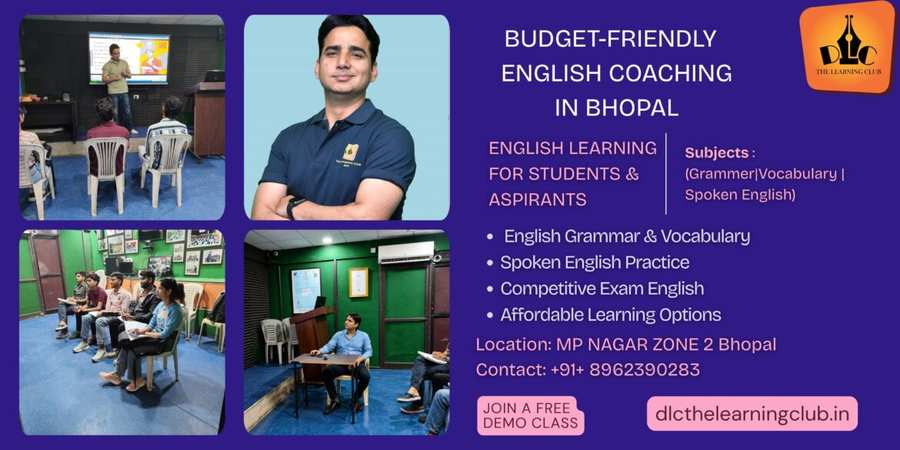
DLC The Learning Club — This one’s in Maharana Pratap Nagar, and they’ve been doing this for 14+ years now, with over 500 students getting selected after their coaching. They’ve got their own method called Vocabmetry for building vocabulary and grammar, and honestly, what stands out is that they cover spoken English AND exam prep together, so you’re not stuck choosing between the two. Free demo class + a sample test before you commit. Call them at 0755-4903008 or 8989780888.

Paramount Institute — Been around since 2006, so this is one of the older, more established names in the city. They focus on communication skills, interview prep, personality development, and also help with SSC/banking English if that’s your goal.

Veta — This is a bigger national chain, and their Bhopal branch runs shorter 60-90 day spoken English programs with daily speaking practice. Good if you want something quick and structured rather than a long drawn-out course.

Inlingua — Part of a global language training network. More standardized curriculum, but tends to cost a bit more than the local institutes — worth it if you want that international-style structure.

British Council & IDP — If IELTS or a Cambridge certification is your actual goal, these are basically the gold standard in Bhopal. Not the cheapest option around, but they bring certified examiners and official material to the table, so the higher price does come with something concrete.

Local coaching centres (via Sulekha, UrbanPro, IndiaMART) — There are also a bunch of smaller, locally-run places offering basic spoken English for as low as ₹300-400 a month. Fine for absolute beginners just starting out, but the quality really varies from place to place — so don’t skip the trial class, whatever you choose.

One Honest Note

There’s a real difference between an institute that’s cheap because it’s cutting corners, and one that’s affordable because it just doesn’t inflate its fees unnecessarily. Before signing up anywhere — DLC included, don’t just take my word for it — go ask: can I sit in a free demo class first? Is there any way to track if I’m actually improving? What exactly does the fee cover?

Also, fees change over time, institutes update their pricing, so double-check current rates directly before you commit to anything.

0 comment
0 FacebookTwitterPinterestEmail
English coaching for bank exams

I’ve lost count of how many times a student has told me some version of this — “Maths I can handle, reasoning too, but English? That’s where I lose everything.” And every time I hear it, I think… yeah, that’s basically most of us.

If you’re prepping for SSC, bank, or railway exams in Bhopal right now, you probably know this feeling already. You sit down, everything’s going fine, and then the English section shows up and suddenly you’re re-reading the same paragraph three times because nothing’s sticking.

Here’s the thing nobody really tells you — we didn’t learn English growing up, we memorized it. Rules, word lists, grammar charts. So when an exam throws something unfamiliar at you, like a tricky comprehension passage, your brain just kind of shuts the door.

I’m not going to hand you another generic “5 tips to improve English” list here. Let’s actually talk about what helps.

Where the Problem Really Sits

Honestly? It’s rarely about not knowing English. It’s the panic. The second the clock starts, something in your head goes “oh no” and even stuff you know well starts feeling shaky.

A comprehension passage takes forever to get through, and by the time you finish reading it once, half your time’s gone. Synonyms and antonyms get jumbled because they were crammed as a list rather than actually understood in context. And if there’s an interview round waiting at the end — that’s a whole different kind of nervous, because talking and writing use completely different muscles.

Sound familiar? It’s fixable. It just needs the right kind of practice, not more of the same thing you’ve already tried.

What Actually Useful Coaching Looks Like

Not all English classes are the same, and that’s worth saying out loud. A lot of them teach general spoken English — great for casual conversation, not so great when you’re staring at an error-spotting question in an exam hall.

What tends to actually move the needle: grammar rules that keep repeating in real exam papers (not the whole textbook, just the parts that matter), vocabulary built around what’s actually asked — one-word substitutions, idioms, and so on — plus practice reading faster without losing the meaning, because time really is the enemy here. And mock tests. Not once in a while, but regularly, so the real exam doesn’t feel like a surprise.

What DLC The Learning Club Brings to the Table

DLC’s been around in Maharana Pratap Nagar for 14 years now, and somewhere along the way, 500+ students walked out with a selection thanks to their prep. They’ve built something called the Vocabmetry method — basically a structured, step-by-step way of building grammar and vocabulary instead of just winging it class after class.

You don’t have to commit blind either — there’s a free demo class first, and a sample test to see exactly where you’re starting from. The full course runs 6 months and covers grammar, vocabulary, comprehension, and spoken English together. Batches stay small too, so your doubts don’t get buried under twenty other hands raised at once.

Before You Sign Up Anywhere — Ask These

Is there a demo class, or are you expected to just trust and pay? Is the coaching actually exam-focused, or is it mostly general spoken English with an exam label slapped on? Do they test your progress along the way, or does it just… continue indefinitely? And realistically, can you get there regularly without it becoming a chore — because half-attended classes rarely help anyone.

One Last Thing

English isn’t going to fix itself in a week, and honestly, be a little suspicious of anyone who promises that. But with consistent, exam-focused practice, that one section that’s been quietly costing you marks can turn into the one that actually pulls your score up.

If this year’s exam is the one you’re serious about, a free demo class costs you nothing but an hour — might as well see what it’s like.

Contact DLC The Learning Club: Kailash Darshan Complex, Maharana Pratap Nagar, Bhopal 0755-4903008 / 8989780888 dlcthelearningclub.in

0 comment
0 FacebookTwitterPinterestEmail
English classes for job seekers in Bhopal interview success tips

Why English Classes Are a Game-Changer for Job Seekers in Bhopal

Let’s be honest — how many times have you had the perfect answer in your head during an interview, but the moment you opened your mouth, the English just… didn’t come out right? You’re not alone. This happens to thousands of talented, hardworking job seekers right here in Bhopal every single day.

Here’s the truth nobody tells you: it’s rarely about your skills. Most of the time, it’s about confidence — and confidence in English is something you can absolutely build.

The Real Problem Isn’t Your Knowledge

You probably know your subject. You’ve done the coursework, maybe even topped your class. But interviews, group discussions, and workplace conversations in India today are increasingly happening in English. And if your spoken English feels shaky, even your best ideas can get lost in translation — literally.

This is exactly why English classes have become so important for job seekers, especially in a growing city like Bhopal where opportunities in IT, banking, customer service, and government sectors all expect at least conversational fluency.

What a Good English Class Actually Does

Forget boring grammar drills and cramming rules you’ll forget in a week. The best classes today focus on something much more useful — real, spoken practice. Think mock interviews, group discussions, everyday conversation practice, and building a strong, work-ready vocabulary.

Bhopal has some excellent coaching institutes that specialize in exactly this. They don’t just teach English as a subject; they train you to think in English, so your responses feel natural instead of translated in your head first. This approach is sometimes called an immersive method — meaning you’re surrounded by the language until it becomes second nature.

Small Steps, Big Confidence

Here’s something encouraging: fluency doesn’t happen overnight, and it doesn’t need to. Even small, consistent practice — daily conversations, reading aloud, watching English videos with subtitles off — adds up fast. Structured classes simply give you a push in the right direction, with a teacher correcting you along the way instead of you guessing alone.

Many job seekers who’ve gone through a good English coaching program in Bhopal say the biggest change wasn’t just their vocabulary — it was how they felt walking into an interview room. Less nervous. More prepared. Ready to actually show who they are, instead of hiding behind broken sentences.

Your Next Step

If you’re currently job hunting and feel like your English is holding you back, don’t just “wait for it to improve on its own.” Join a class, practice actively, and give yourself the tools to speak with confidence. Because at the end of the day, your knowledge deserves to be heard clearly — not lost because of nervous, hesitant English.

Bhopal’s job market is growing. Make sure your English grows with it.

0 comment
0 FacebookTwitterPinterestEmail
right-english-word-disappear-when-you-need-it

You know the word.

Someone asks you something in English.

And suddenly your brain goes:

“Wait… I KNOW this.”

Nothing comes.

You somehow finish the conversation.

If this happens to you often, here’s the important part:

You may not have a vocabulary problem.

You may have a recall problem.

Try This 10-Second Test

What English word would you use for:

1. Extremely tired…

2. Moving a meeting to a later date…

3. Not really willing to do something…

Answers:

Exhausted

Postpone

Reluctant

You probably knew these words.

But did they come instantly?


Why This Happens

Think of vocabulary in two boxes:

👀 Words you recognise

Someone says:

“I’m overwhelmed.”

You immediately understand them.

🗣️ Words you can recall

Someone asks:

“How are you feeling with all this work?”

And overwhelmed comes to your mind by itself.

Those two boxes are not always the same size.

That’s why you can watch English videos perfectly…

…and still get stuck while speaking.


The Vocabulary Mistake Most People Make

❌ Word → Meaning → Next Word
✅ Word → Situation → Sentence → Recall

Use the 3–2–1 Rule

Whenever you learn an English word:

3 – Imagine 3 situations

Where could I actually use this?

2 – Make 2 sentences

Preferably about your own life.

1 – Recall it tomorrow

Without looking at the word first.

Example:

Overwhelmed

Situation 1: Too much office work

Situation 2: Too many assignments

Situation 3: Too many things going wrong together

Sentences:

“I’ve been overwhelmed with work lately.”

“She felt overwhelmed by everything happening at once.”

Tomorrow ask yourself:

What word would I use when everything feels like too much?

If overwhelmed appears…

that’s progress.


And When You Forget a Word While Speaking?

Do not stop the entire conversation.

Can’t remember receipt?

Instead of:

“Umm… wait… I know this word…”

Say:

“The paper they give you after you pay.”

This is a speaking skill too.

Fluency doesn’t mean:

“I never forget a word.”

It means:

“One forgotten word can’t stop me from speaking.”


If You Learn Words but Forget Them While Speaking…

Learning more words isn’t always the answer.

Sometimes you need to make the words you learn more memorable.

That’s also the idea behind Vocabmetry®, the vocabulary-learning methodology used by DLC The Learning Club.

Instead of treating vocabulary like:

Word → Definition → Memorise

Vocabmetry uses stories, characters and visual associations to make words easier to connect with something memorable.

So if your biggest problem is:

“I learn vocabulary, but the word doesn’t come when I actually need it…”

you can explore Vocabmetry® and the Vocabulary Course by DLC The Learning Club. Because knowing a word is useful.

But remembering it at the right moment is what actually changes your English.

0 comment
0 FacebookTwitterPinterestEmail

1. What Is the Plastic End of a Shoelace Called? – Aglet

Plastic end of a shoelace called an aglet

Look at your shoelace.

That tiny plastic or metal covering at its end has its own name:
Aglet.

Pronounced roughly: AG-let

Its job is simple but important – it keeps the shoelace from fraying and makes it easier to push through the holes in your shoe.


2. What Is the Buttoned Strip on the Front of a Shirt Called? – Placket

Buttoned strip on the front of a shirt called a placket

Take a shirt and look at the strip where the buttons and buttonholes usually sit.

That area is called the placket.

A placket is an opening or piece of fabric in clothing where the garment fastens.

This is a word you may actually encounter while shopping for clothes online.


3. What Is That Extra Piece of Fabric Added for Strength or Movement? – Gusset

Extra piece of fabric added for strength or movement called a gusset

Some trousers, bags, shoes and other products have an extra piece of material inserted into a seam.

That piece is called a gusset.

A gusset is usually added to provide extra room, reinforcement or flexibility.

You’ve probably seen the word before without noticing it:

gusseted bag

gusseted pocket

underarm gusset

Now you’ll know what the description means.


4. What Is the Metal Part That Holds a Pencil’s Eraser Called? – Ferrule

Metal part that holds a pencil eraser called a ferrule

Take a traditional pencil with an eraser.

Between the wooden pencil and the eraser is usually a small metal band.

That is a ferrule.

Ferrules aren’t limited to pencils. The word can refer to metal rings or sleeves used to strengthen or join parts of objects, including paintbrushes and tool handles.


5. What Are the Pointed Parts of a Fork Called? – Tines

Pointed parts of a fork called tines

A fork doesn’t technically have “teeth.”

Those long pointed parts are called tines.

Usually, when someone asks for a fork, you don’t need this word.

But imagine describing a damaged one:

“One of those pointy fork things is bent.”

You can say:

“One of the tines is bent.”

That is what precise vocabulary does.

It shortens your sentences.


Want to actually use better words while speaking, not just memorize them?

I found the Vocabulary Course by DLC The Learning Club and Speed Dictionary really useful for building vocabulary in a more practical way. Worth checking out if you’re trying to improve your English.

Author: Riya Sharma (Banking Exam Aspirant)
0 comment
0 FacebookTwitterPinterestEmail

SSC CGL 2026 • Tier 1 English

SSC CGL 2026 Tier 1 is approaching, and English can become one of the most scoring sections if your vocabulary is strong.

According to the official SSC CGL 2026 notification, Tier 1 is tentatively scheduled for August–September 2026. The Tier 1 examination contains 25 English Comprehension questions carrying 50 marks, with a sectional timer of 15 minutes. There is also a negative marking of 0.50 marks for every incorrect answer.

That makes quick recognition of words especially useful. If you already understand a word, you can often answer a synonym, antonym, contextual vocabulary or comprehension question in seconds rather than trying to guess its meaning during the examination.

25English Questions
50English Marks
0.50Negative Marking

How Were These 100 Words Selected?

This is not an official list released by SSC.

For this article, we studied vocabulary reported in previous SSC examinations and cross-checked it with current SSC CGL preparation resources.

PracticeMock maintains a compilation of more than 600 synonyms reported from previous SSC examinations, containing words such as Intrepid, Abrogate, Diligent, Censure, Panacea, Prudent, Laconic, Haughty, Meticulous, Taciturn and many others included below.

The selection was also cross-checked against current SSC CGL vocabulary collections from Testbook, Physics Wallah and Oliveboard, which similarly focus on high-frequency vocabulary and previous-exam patterns.

SSC also maintains an official section for previous-year question papers, which students should use alongside vocabulary revision.

The purpose of this list is simple: learn 100 useful, exam-oriented words instead of trying to memorise thousands of words without any direction.

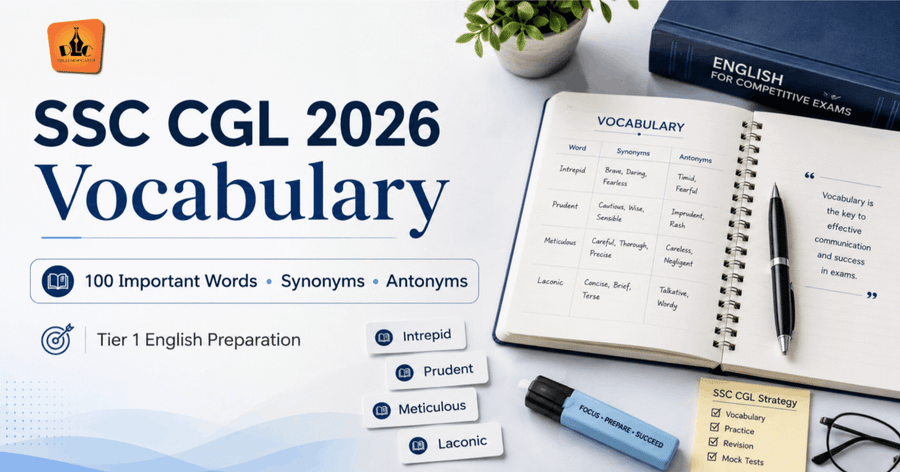
100 Important Vocabulary Words for SSC CGL 2026

Meaning, Hindi meaning, synonyms, antonyms, example and a quick memory tip for every word.

1
Intrepid
Meaning: Extremely brave and fearless
Hindi Meaning: निडर, साहसी
Synonyms: Fearless, dauntless, courageous
Antonyms: Timid, cowardly, fearful
Example: The intrepid rescue team entered the dangerous building.
Memory Tip: Trepidation means fear. Intrepid means showing no fear.
2
Abrogate
Meaning: To officially cancel or abolish something
Hindi Meaning: निरस्त करना, रद्द करना
Synonyms: Repeal, abolish, revoke
Antonyms: Establish, enact, approve
Example: The authorities decided to abrogate the outdated rule.
Memory Tip: If a rule is abrogated, it is removed.
3
Deference
Meaning: Polite respect for another person
Hindi Meaning: आदर, सम्मान
Synonyms: Respect, regard, submission
Antonyms: Disrespect, defiance, contempt
Example: The employees treated the senior scientist with deference.
Memory Tip: To defer to someone is to respect their judgement.
4
Obnoxious
Meaning: Extremely unpleasant or offensive
Hindi Meaning: अत्यंत अप्रिय, घृणित
Synonyms: Offensive, disgusting, unpleasant
Antonyms: Pleasant, agreeable, delightful
Example: His obnoxious behaviour irritated everyone in the room.
Memory Tip: Obnoxious = something you strongly dislike being around.
5
Proliferate
Meaning: To increase or spread rapidly
Hindi Meaning: तेजी से बढ़ना या फैलना
Synonyms: Multiply, increase, spread
Antonyms: Decline, diminish, decrease
Example: Online learning platforms have proliferated in recent years.
Memory Tip: Think of prolific — producing a lot.
6
Paradox
Meaning: A statement or situation that appears contradictory but may still be true
Hindi Meaning: विरोधाभास
Synonyms: Contradiction, puzzle, anomaly
Antonyms: Consistency, certainty
Example: It is a paradox that more choices can sometimes make decisions harder.
Memory Tip: Paradox = apparently opposite ideas together.
7
Colossal
Meaning: Extremely large or great
Hindi Meaning: विशाल, बहुत बड़ा
Synonyms: Enormous, gigantic, immense
Antonyms: Tiny, minute, small
Example: The project required a colossal amount of planning.
Memory Tip: Think of a giant colossus.
8
Inception
Meaning: The beginning or starting point of something
Hindi Meaning: आरंभ, शुरुआत
Synonyms: Beginning, commencement, origin
Antonyms: End, conclusion, termination
Example: She has worked with the organisation since its inception.
Memory Tip: Inception = when something comes into existence.
9
Grandeur
Meaning: Magnificence or impressive beauty
Hindi Meaning: भव्यता, वैभव
Synonyms: Magnificence, splendour, majesty
Antonyms: Simplicity, plainness, modesty
Example: Tourists admired the grandeur of the historic palace.
Memory Tip: Grand → Grandeur.
10
Infatuation
Meaning: An intense but usually short-lived admiration or attraction
Hindi Meaning: मोह, तीव्र आकर्षण
Synonyms: Fascination, passion, obsession
Antonyms: Indifference, dislike
Example: What he considered love was only a temporary infatuation.
Memory Tip: Infatuation is usually intense but temporary.
11
Momentous
Meaning: Extremely important or significant
Hindi Meaning: अत्यंत महत्वपूर्ण
Synonyms: Significant, important, consequential
Antonyms: Trivial, insignificant, minor
Example: The court delivered a momentous judgement.
Memory Tip: A momentous event creates an important moment in history.
12
Quiver
Meaning: To shake slightly and rapidly
Hindi Meaning: कांपना
Synonyms: Tremble, shiver, shake
Antonyms: Steady, remain still
Example: His voice began to quiver during the speech.
Memory Tip: Quiver = a small, quick tremble.
13
Adulation
Meaning: Excessive admiration or praise
Hindi Meaning: अत्यधिक प्रशंसा
Synonyms: Flattery, praise, worship
Antonyms: Criticism, condemnation
Example: The actor received enormous adulation from his fans.
Memory Tip: Adulation is more than normal praise.
14
Contemplation
Meaning: Deep and careful thought
Hindi Meaning: गहन विचार, चिंतन
Synonyms: Reflection, meditation, consideration
Antonyms: Thoughtlessness, disregard
Example: After careful contemplation, she accepted the offer.
Memory Tip: Contemplate = think deeply.
15
Diligent
Meaning: Hard-working and careful
Hindi Meaning: परिश्रमी, मेहनती
Synonyms: Industrious, hardworking, attentive
Antonyms: Lazy, careless, negligent
Example: A diligent student revises regularly rather than only before the exam.
Memory Tip: Diligent people consistently do their work.
16
Censure
Meaning: To strongly or formally criticise
Hindi Meaning: कड़ी निंदा करना
Synonyms: Condemn, criticise, rebuke
Antonyms: Praise, approve, commend
Example: The committee censured the official for misconduct.
Memory Tip: Censure = serious criticism.
17
Fatal
Meaning: Causing death or disastrous consequences
Hindi Meaning: घातक
Synonyms: Deadly, lethal, mortal
Antonyms: Harmless, safe, nonfatal
Example: A fatal mistake can completely change an outcome.
Memory Tip: Fatal → fatality.
18
Doleful
Meaning: Full of sadness
Hindi Meaning: दुखी, शोकपूर्ण
Synonyms: Mournful, sorrowful, gloomy
Antonyms: Cheerful, joyful, happy
Example: He had a doleful expression after hearing the news.
Memory Tip: Doleful = full of sorrow.
19
Gruff
Meaning: Rough in manner or voice
Hindi Meaning: रूखा, कर्कश
Synonyms: Harsh, rough, brusque
Antonyms: Gentle, pleasant, polite
Example: His voice sounded gruff, although he was actually friendly.
Memory Tip: Gruff sounds rough — and often means rough.
20
Fidelity
Meaning: Faithfulness or loyalty
Hindi Meaning: निष्ठा, वफादारी
Synonyms: Loyalty, devotion, faithfulness
Antonyms: Betrayal, disloyalty, infidelity
Example: The officer was respected for his fidelity to his duties.
Memory Tip: Fidelity = faithful.
21
Infructuous
Meaning: Producing no useful result
Hindi Meaning: निष्फल, बेनतीजा
Synonyms: Fruitless, futile, unproductive
Antonyms: Fruitful, productive, successful
Example: Several infructuous attempts were made to resolve the issue.
Memory Tip: In-fructuous = without fruit → without result.
22
Garnish
Meaning: To decorate or embellish something
Hindi Meaning: सजाना
Synonyms: Adorn, decorate, embellish
Antonyms: Strip, spoil, disfigure
Example: The chef garnished the dish with fresh herbs.
Memory Tip: A garnish makes something look better.
23
Mentor
Meaning: An experienced person who guides another person
Hindi Meaning: मार्गदर्शक
Synonyms: Adviser, guide, counsellor
Antonyms: Novice, pupil
Example: A good mentor can help students avoid common mistakes.
Memory Tip: Mentor = experienced guide.
24
Superstitious
Meaning: Having irrational beliefs about luck or supernatural influences
Hindi Meaning: अंधविश्वासी
Synonyms: Credulous, irrationally believing
Antonyms: Rational, sceptical
Example: He was superstitious about travelling on certain dates.
Memory Tip: Superstition → superstitious.
25
Ravage
Meaning: To cause severe destruction
Hindi Meaning: तबाह करना, बर्बाद करना
Synonyms: Devastate, destroy, ruin
Antonyms: Restore, repair, protect
Example: The cyclone ravaged several coastal villages.
Memory Tip: Ravage = severe damage.
26
Successive
Meaning: Following one after another
Hindi Meaning: लगातार, क्रमिक
Synonyms: Consecutive, sequential, following
Antonyms: Intermittent, nonconsecutive
Example: The team won three successive matches.
Memory Tip: Successive things come in succession.
27
Delineate
Meaning: To describe or explain something precisely
Hindi Meaning: स्पष्ट रूप से वर्णन करना
Synonyms: Describe, outline, portray
Antonyms: Confuse, obscure
Example: The report delineates the responsibilities of each department.
Memory Tip: Delineate = draw the lines clearly.
28
Menace
Meaning: A person or thing that threatens danger or harm
Hindi Meaning: खतरा
Synonyms: Threat, danger, hazard
Antonyms: Protection, safeguard
Example: Reckless driving is a menace to public safety.
Memory Tip: Menace = threat.
29
Occult
Meaning: Mysterious, supernatural or hidden from ordinary knowledge
Hindi Meaning: रहस्यमय, अलौकिक
Synonyms: Supernatural, mystical, mysterious
Antonyms: Natural, ordinary, evident
Example: The novel contains references to occult practices.
Memory Tip: Occult = hidden or mysterious.
30
Vindicate
Meaning: To clear someone of blame or prove something to be right
Hindi Meaning: दोषमुक्त सिद्ध करना, सही साबित करना
Synonyms: Justify, exonerate, clear
Antonyms: Blame, condemn, incriminate
Example: New evidence vindicated the accused employee.
Memory Tip: Vindicated = proved right.
31
Benevolence
Meaning: Kindness and willingness to help others
Hindi Meaning: परोपकार, दयालुता
Synonyms: Kindness, generosity, charity
Antonyms: Cruelty, malevolence, hostility
Example: The organisation is known for its benevolence toward disadvantaged children.
Memory Tip: Bene = good. Benevolence = goodwill.
32
Panacea
Meaning: A supposed solution for every problem
Hindi Meaning: हर समस्या का समाधान, सर्वरोगहारी उपाय
Synonyms: Cure-all, universal remedy
Antonyms: —
Example: Technology is useful, but it is not a panacea for every educational problem.
Memory Tip: Panacea = one cure for everything.
33
Prudent
Meaning: Wise and careful about future consequences
Hindi Meaning: विवेकपूर्ण, समझदार
Synonyms: Cautious, sensible, judicious
Antonyms: Reckless, careless, imprudent
Example: Saving part of your income is a prudent decision.
Memory Tip: Prudent people think before acting.
34
Amicable
Meaning: Friendly and peaceful
Hindi Meaning: मैत्रीपूर्ण
Synonyms: Friendly, cordial, harmonious
Antonyms: Hostile, unfriendly, antagonistic
Example: Both parties reached an amicable settlement.
Memory Tip: Amigo means friend → amicable = friendly.
35
Irreverence
Meaning: Lack of proper respect
Hindi Meaning: अनादर
Synonyms: Disrespect, impudence
Antonyms: Reverence, respect, admiration
Example: His irreverence toward the institution offended many people.
Memory Tip: Reverence = respect; irreverence = lack of respect.
36
Ceremonial
Meaning: Connected with a formal ceremony
Hindi Meaning: औपचारिक, अनुष्ठानिक
Synonyms: Formal, ritualistic
Antonyms: Informal, casual
Example: The president performed the ceremonial opening of the event.
Memory Tip: Ceremony → ceremonial.
37
Propitiate
Meaning: To win someone’s favour or reduce their anger
Hindi Meaning: मनाना, प्रसन्न करना
Synonyms: Appease, pacify, placate
Antonyms: Provoke, anger, irritate
Example: He attempted to propitiate the angry customer with an apology.
Memory Tip: Propitiate = make an angry person pleased again.
38
Capitulate
Meaning: To stop resisting and surrender
Hindi Meaning: आत्मसमर्पण करना
Synonyms: Surrender, yield, submit
Antonyms: Resist, oppose, defy
Example: The opposition refused to capitulate despite intense pressure.
Memory Tip: Capitulate = give up resistance.
39
Estranged
Meaning: No longer close or friendly with someone
Hindi Meaning: अलग हुआ, संबंध-विच्छेद हुआ
Synonyms: Alienated, separated, detached
Antonyms: Reconciled, close, united
Example: He eventually reconciled with his estranged brother.
Memory Tip: Estranged people become strangers to each other.
40
Restive
Meaning: Unable to remain calm or still
Hindi Meaning: बेचैन
Synonyms: Restless, uneasy, impatient
Antonyms: Calm, peaceful, composed
Example: The audience became restive after the long delay.
Memory Tip: Restive = restless.
41
Nomadic
Meaning: Moving from place to place rather than living permanently in one place
Hindi Meaning: घुमंतू
Synonyms: Wandering, roaming, migratory
Antonyms: Settled, stationary
Example: The community traditionally followed a nomadic lifestyle.
Memory Tip: Nomads move from place to place.
42
Derogatory
Meaning: Showing disrespect or criticism
Hindi Meaning: अपमानजनक
Synonyms: Disparaging, insulting, demeaning
Antonyms: Complimentary, respectful, flattering
Example: The organisation condemned the derogatory remarks.
Memory Tip: Derogatory remarks put someone down.
43
Premonition
Meaning: A strong feeling that something is about to happen
Hindi Meaning: पूर्वाभास
Synonyms: Forewarning, foreboding, presentiment
Antonyms: —
Example: She had a strange premonition that something would go wrong.
Memory Tip: Pre = before. Premonition = feeling something beforehand.
44
Elude
Meaning: To escape or avoid something skilfully
Hindi Meaning: बच निकलना
Synonyms: Escape, evade, avoid
Antonyms: Confront, encounter, surrender
Example: The suspect managed to elude the police.
Memory Tip: Elude = evade.
45
Flutter
Meaning: To move or flap quickly and lightly
Hindi Meaning: फड़फड़ाना
Synonyms: Flap, flicker, quiver
Antonyms: Remain still
Example: The flags fluttered in the wind.
Memory Tip: Think of butterfly wings fluttering.
46
Priority
Meaning: Something considered more important than other things
Hindi Meaning: प्राथमिकता
Synonyms: Precedence, preference, importance
Antonyms: Unimportance, inferiority
Example: Safety should always be our first priority.
Memory Tip: Priority = what comes first.
47
Duplication
Meaning: The act of making or doing something again or making a copy
Hindi Meaning: नकल, दोहराव
Synonyms: Copying, repetition, replication
Antonyms: Originality, uniqueness
Example: The new system prevents unnecessary duplication of work.
Memory Tip: Duplicate = another copy.
48
Transparent
Meaning: Easy to see through; also open and easy to understand
Hindi Meaning: पारदर्शी, स्पष्ट
Synonyms: Clear, lucid, open
Antonyms: Opaque, obscure, secretive
Example: Recruitment procedures should be fair and transparent.
Memory Tip: Transparent glass lets you see through it.
49
Dexterity
Meaning: Skill in performing tasks, especially with the hands
Hindi Meaning: निपुणता, कौशल
Synonyms: Skill, adroitness, proficiency
Antonyms: Clumsiness, ineptitude
Example: The surgeon performed the procedure with remarkable dexterity.
Memory Tip: Dexterity = skilled handling.
50
Capricious
Meaning: Changing suddenly and unpredictably
Hindi Meaning: मनमौजी, अस्थिर
Synonyms: Fickle, whimsical, unpredictable
Antonyms: Stable, consistent, predictable
Example: The region is known for its capricious weather.
Memory Tip: Capricious = changes without warning.
51
Assertive
Meaning: Confident in expressing one’s opinions or needs
Hindi Meaning: आत्मविश्वासी, दृढ़
Synonyms: Confident, forceful, self-assured
Antonyms: Timid, passive, submissive
Example: Candidates should be assertive without becoming aggressive.
Memory Tip: Assert = state strongly.
52
Knavish
Meaning: Dishonest or untrustworthy
Hindi Meaning: बेईमान, धूर्त
Synonyms: Dishonest, unscrupulous, deceitful
Antonyms: Honest, honourable, upright
Example: The character used knavish methods to obtain money.
Memory Tip: A knave is a dishonest person.
53
Laconic
Meaning: Using very few words
Hindi Meaning: कम शब्दों में बोलने वाला
Synonyms: Concise, brief, terse
Antonyms: Verbose, loquacious, wordy
Example: His laconic reply consisted of only two words.
Memory Tip: Laconic = short speech.
54
Knack
Meaning: A natural or acquired ability to do something well
Hindi Meaning: विशेष कौशल
Synonyms: Skill, talent, aptitude
Antonyms: Inability, ineptitude
Example: She has a knack for explaining difficult concepts simply.
Memory Tip: Having a knack = being naturally good at something.
55
Haughty
Meaning: Arrogantly proud and superior
Hindi Meaning: घमंडी
Synonyms: Arrogant, conceited, proud
Antonyms: Humble, modest, meek
Example: His haughty attitude made him unpopular among his colleagues.
Memory Tip: Haughty = acting “high” above everyone.
56
Enliven
Meaning: To make something more lively or interesting
Hindi Meaning: जीवंत बनाना
Synonyms: Cheer, animate, brighten
Antonyms: Dull, depress, bore
Example: Her humour enlivened the otherwise serious discussion.
Memory Tip: Enliven = put life into something.
57
Genuine
Meaning: Real and authentic
Hindi Meaning: असली, वास्तविक
Synonyms: Authentic, real, legitimate
Antonyms: Fake, false, counterfeit
Example: Always verify whether the document is genuine.
Memory Tip: Genuine = not fake.
58
Transition
Meaning: The process of changing from one state to another
Hindi Meaning: परिवर्तन, संक्रमण
Synonyms: Change, shift, transformation
Antonyms: Continuation, permanence
Example: The organisation made a smooth transition to the new system.
Memory Tip: Transition = movement from one stage to another.
59
Decrepitude
Meaning: A state of weakness or deterioration, especially because of age
Hindi Meaning: जर्जर अवस्था
Synonyms: Feebleness, deterioration, decay
Antonyms: Strength, vigour
Example: Years of neglect left the building in a state of decrepitude.
Memory Tip: Decrepit → decrepitude.
60
Audacity
Meaning: Boldness or willingness to take daring risks
Hindi Meaning: दुस्साहस, निर्भीकता
Synonyms: Boldness, daring, nerve
Antonyms: Timidity, cowardice, fear
Example: Everyone was surprised by the audacity of his proposal.
Memory Tip: Audacity = unusually bold behaviour.
61
Accede
Meaning: To agree to a request, proposal or demand
Hindi Meaning: सहमत होना
Synonyms: Consent, agree, assent
Antonyms: Refuse, reject, decline
Example: The administration finally acceded to the request.
Memory Tip: Accede = say yes to a demand.
62
Alert
Meaning: Quick to notice possible danger or problems
Hindi Meaning: सतर्क
Synonyms: Watchful, vigilant, attentive
Antonyms: Careless, unaware, inattentive
Example: Drivers must remain alert on crowded roads.
Memory Tip: Alert = awake and watchful.
63
Obstinate
Meaning: Stubbornly refusing to change one’s opinion or behaviour
Hindi Meaning: हठी, जिद्दी
Synonyms: Stubborn, inflexible, headstrong
Antonyms: Flexible, compliant, yielding
Example: He remained obstinate despite repeated warnings.
Memory Tip: Obstinate = stubborn.
64
Yardstick
Meaning: A standard used for comparison or judgement
Hindi Meaning: मापदंड
Synonyms: Standard, criterion, benchmark
Antonyms: —
Example: Marks alone should not be the only yardstick of intelligence.
Memory Tip: A physical yardstick measures length; figuratively, it measures quality.
65
Toxic
Meaning: Poisonous or extremely harmful
Hindi Meaning: विषैला, हानिकारक
Synonyms: Poisonous, harmful, lethal
Antonyms: Harmless, safe, beneficial
Example: The factory released toxic chemicals into the water.
Memory Tip: Toxic → toxin → poison.
66
Regress
Meaning: To return to a worse or less developed state
Hindi Meaning: पीछे लौटना, पिछड़ना
Synonyms: Backslide, deteriorate, revert
Antonyms: Progress, advance, improve
Example: Without regular practice, language skills may regress.
Memory Tip: Progress = forward; regress = backward.
67
Sombre
Meaning: Serious, dark or gloomy
Hindi Meaning: उदास, गंभीर
Synonyms: Gloomy, solemn, melancholy
Antonyms: Cheerful, bright, joyful
Example: The ceremony had a sombre atmosphere.
Memory Tip: Sombre = serious and gloomy.
68
Rare
Meaning: Uncommon or not frequently occurring
Hindi Meaning: दुर्लभ
Synonyms: Scarce, uncommon, unusual
Antonyms: Common, frequent, plentiful
Example: The museum contains several rare manuscripts.
Memory Tip: Rare = difficult to find.
69
Hurdle
Meaning: A problem or obstacle that must be overcome
Hindi Meaning: बाधा
Synonyms: Obstacle, barrier, difficulty
Antonyms: Aid, assistance, advantage
Example: Lack of confidence can become a major hurdle during interviews.
Memory Tip: In a race, you jump over hurdles.
70
Decimate
Meaning: To destroy or severely reduce a large proportion of something
Hindi Meaning: भारी नुकसान करना, बड़ी संख्या में नष्ट करना
Synonyms: Devastate, destroy, ravage
Antonyms: Preserve, protect, restore
Example: The disease decimated the local crop.
Memory Tip: Decimate = cause devastating loss.
71
Avarice
Meaning: Extreme greed for money or wealth
Hindi Meaning: अत्यधिक लालच
Synonyms: Greed, cupidity, acquisitiveness
Antonyms: Generosity, charity, selflessness
Example: His avarice eventually destroyed his reputation.
Memory Tip: Avarice = greed for wealth.
72
Eternal
Meaning: Lasting forever
Hindi Meaning: शाश्वत, अनंत
Synonyms: Everlasting, perpetual, endless
Antonyms: Temporary, brief, transient
Example: Many poems explore the idea of eternal love.
Memory Tip: Eternal = without an end.
73
Flabbergasted
Meaning: Extremely surprised or shocked
Hindi Meaning: बेहद हैरान
Synonyms: Astonished, dumbfounded, amazed
Antonyms: Unimpressed, unsurprised
Example: She was flabbergasted by the unexpected result.
Memory Tip: Flabbergasted = much stronger than simply surprised.
74
Dubious
Meaning: Doubtful, suspicious or uncertain
Hindi Meaning: संदिग्ध, संदेहपूर्ण
Synonyms: Doubtful, questionable, uncertain
Antonyms: Certain, trustworthy, definite
Example: The examiner found his explanation dubious.
Memory Tip: Dubious → doubt.
75
Antipathy
Meaning: A strong feeling of dislike
Hindi Meaning: घृणा, विरक्ति
Synonyms: Aversion, hostility, dislike
Antonyms: Affection, liking, fondness
Example: He has always had an antipathy towards dishonesty.
Memory Tip: Anti = against → antipathy = strong dislike.
76
Rescind
Meaning: To officially cancel or revoke something
Hindi Meaning: रद्द करना
Synonyms: Revoke, cancel, repeal
Antonyms: Approve, enact, confirm
Example: The authority decided to rescind the earlier order.
Memory Tip: Rescind = officially take back.
77
Meticulous
Meaning: Extremely careful about small details
Hindi Meaning: अत्यंत सावधान, सूक्ष्मता से काम करने वाला
Synonyms: Careful, precise, methodical
Antonyms: Careless, negligent, sloppy
Example: She kept meticulous records of every transaction.
Memory Tip: Meticulous people notice tiny details.
78
Indignation
Meaning: Anger caused by something considered unfair or wrong
Hindi Meaning: आक्रोश, रोष
Synonyms: Outrage, resentment, anger
Antonyms: Approval, pleasure, acceptance
Example: The unfair decision caused widespread indignation.
Memory Tip: Indignation = anger at injustice.
79
Incapacitate
Meaning: To make someone unable to function normally
Hindi Meaning: अक्षम कर देना
Synonyms: Disable, cripple, immobilise
Antonyms: Enable, strengthen, empower
Example: The injury incapacitated him for several weeks.
Memory Tip: Incapable → incapacitate = make incapable.
80
Philanthropist
Meaning: A person who helps others, particularly through charitable giving
Hindi Meaning: परोपकारी व्यक्ति
Synonyms: Benefactor, humanitarian, donor
Antonyms: Miser
Example: The philanthropist funded scholarships for hundreds of students.
Memory Tip: Philanthropist = person who gives for public good.
81
Decamp
Meaning: To leave a place suddenly or secretly
Hindi Meaning: अचानक निकल जाना
Synonyms: Flee, depart, escape
Antonyms: Stay, remain
Example: The thieves decamped before the police arrived.
Memory Tip: De-camp = leave the camp.
82
Salient
Meaning: Most noticeable or important
Hindi Meaning: प्रमुख, मुख्य
Synonyms: Prominent, notable, important
Antonyms: Insignificant, inconspicuous
Example: The report summarises the salient points of the policy.
Memory Tip: Salient point = main point.
83
Abysmal
Meaning: Extremely bad; also extremely deep
Hindi Meaning: अत्यंत खराब, बहुत गहरा
Synonyms: Dreadful, terrible, appalling
Antonyms: Excellent, outstanding, superb
Example: The team’s performance was abysmal.
Memory Tip: Abyss = very deep → abysmal can mean extremely low/bad.
84
Flair
Meaning: A natural talent or special ability
Hindi Meaning: प्राकृतिक प्रतिभा
Synonyms: Talent, aptitude, gift
Antonyms: Inability, ineptitude
Example: She has a natural flair for languages.
Memory Tip: Flair = natural talent.
85
Illicit
Meaning: Forbidden by law, rules or accepted standards
Hindi Meaning: अवैध
Synonyms: Illegal, unlawful, prohibited
Antonyms: Legal, lawful, permitted
Example: Authorities launched an investigation into the illicit trade.
Memory Tip: Illicit = illegal.
86
Prodigal
Meaning: Spending money or resources wastefully
Hindi Meaning: फिजूलखर्च
Synonyms: Wasteful, extravagant, lavish
Antonyms: Frugal, economical, thrifty
Example: His prodigal spending quickly exhausted his savings.
Memory Tip: Prodigal = spends excessively.
87
Frontier
Meaning: A border or boundary between territories; also the limit of knowledge or development
Hindi Meaning: सीमा, सीमांत
Synonyms: Boundary, border, limit
Antonyms: Interior, centre
Example: Scientists continue to explore new frontiers in medicine.
Memory Tip: Frontier = outer boundary.
88
Felicity
Meaning: Intense happiness or a state of being happy
Hindi Meaning: प्रसन्नता, आनंद
Synonyms: Bliss, happiness, joy
Antonyms: Misery, sorrow, sadness
Example: The family celebrated the occasion with great felicity.
Memory Tip: Felicity = happiness.
89
Irreproachable
Meaning: So good that no criticism can reasonably be made
Hindi Meaning: निर्दोष, आलोचना से परे
Synonyms: Faultless, impeccable, blameless
Antonyms: Blameworthy, faulty, disgraceful
Example: Her professional conduct was irreproachable.
Memory Tip: Reproach = blame; irreproachable = cannot be blamed.
90
Ostracise
Meaning: To exclude someone from a group or society
Hindi Meaning: बहिष्कृत करना
Synonyms: Exclude, banish, shun
Antonyms: Include, welcome, accept
Example: He was ostracised by the group after repeatedly breaking its rules.
Memory Tip: Ostracise = shut someone out.
91
Debacle
Meaning: A sudden and complete failure
Hindi Meaning: करारी विफलता
Synonyms: Fiasco, disaster, failure
Antonyms: Success, triumph, achievement
Example: Poor planning turned the event into a debacle.
Memory Tip: Debacle = disastrous failure.
92
Trite
Meaning: Overused and therefore no longer interesting or original
Hindi Meaning: घिसा-पिटा
Synonyms: Commonplace, clichéd, hackneyed
Antonyms: Original, fresh, novel
Example: The essay relied on trite expressions instead of original arguments.
Memory Tip: Trite = said too many times.
93
Stringent
Meaning: Very strict or demanding
Hindi Meaning: सख्त, कठोर
Synonyms: Strict, rigorous, severe
Antonyms: Lenient, relaxed, flexible
Example: The laboratory follows stringent safety standards.
Memory Tip: Stringent rules = strict rules.
94
Artful
Meaning: Clever or skilful, sometimes in a deceptive way
Hindi Meaning: चालाक, कुशल
Synonyms: Cunning, crafty, skilful
Antonyms: Naive, straightforward, artless
Example: The lawyer used an artful argument to strengthen the case.
Memory Tip: Artful = cleverly constructed.
95
Fatuous
Meaning: Foolish and pointless
Hindi Meaning: मूर्खतापूर्ण, निरर्थक
Synonyms: Silly, foolish, absurd
Antonyms: Sensible, intelligent, wise
Example: Everyone ignored his fatuous suggestion.
Memory Tip: Fatuous = foolish.
96
Perquisite
Meaning: A benefit received because of one’s job or position
Hindi Meaning: पद से मिलने वाला विशेष लाभ या सुविधा
Synonyms: Perk, privilege, benefit
Antonyms: Disadvantage, deprivation
Example: Free accommodation was one of the perquisites of the post.
Memory Tip: Perquisite → perk.
97
Virulent
Meaning: Extremely harmful, severe or hostile
Hindi Meaning: अत्यंत हानिकारक, उग्र
Synonyms: Deadly, severe, poisonous
Antonyms: Harmless, mild, benign
Example: Researchers were studying a particularly virulent strain of the disease.
Memory Tip: Virulent = violently harmful.
98
Loquacious
Meaning: Tending to talk a lot
Hindi Meaning: बहुत बोलने वाला
Synonyms: Talkative, chatty, verbose
Antonyms: Taciturn, reserved, silent
Example: The normally quiet student became surprisingly loquacious during the discussion.
Memory Tip: Loquacious = loves lots of conversation.
99
Taciturn
Meaning: Speaking very little
Hindi Meaning: कम बोलने वाला
Synonyms: Silent, reserved, reticent
Antonyms: Talkative, loquacious, communicative
Example: The taciturn officer rarely participated in casual conversations.
Memory Tip: Tacit means unspoken → taciturn people say little.
100
Transient
Meaning: Existing or lasting only for a short time
Hindi Meaning: अस्थायी, क्षणिक
Synonyms: Temporary, fleeting, transitory
Antonyms: Permanent, lasting, enduring
Example: Fame can sometimes be transient.
Memory Tip: Transit means movement — something transient does not remain for long.

Want to make vocabulary easier to remember?

Explore DLC The Learning Club’s books and online learning resources, or message us directly if you need help choosing the right option.

25 Synonym Questions for SSC CGL Practice

Try answering these without checking the vocabulary list.

1. Select the synonym of INTREPID.
A. Timid
B. Fearless
C. Weak
D. Nervous
2. Select the synonym of ABROGATE.
A. Introduce
B. Repeal
C. Continue
D. Support
3. Select the synonym of OBNOXIOUS.
A. Pleasant
B. Offensive
C. Useful
D. Gentle
4. Select the synonym of PROLIFERATE.
A. Multiply
B. Destroy
C. Separate
D. Restrict
5. Select the synonym of COLOSSAL.
A. Tiny
B. Average
C. Enormous
D. Narrow
6. Select the synonym of DILIGENT.
A. Industrious
B. Negligent
C. Lazy
D. Careless
7. Select the synonym of CENSURE.
A. Appreciate
B. Condemn
C. Protect
D. Celebrate
8. Select the synonym of PRUDENT.
A. Reckless
B. Cautious
C. Foolish
D. Careless
9. Select the synonym of AMICABLE.
A. Hostile
B. Friendly
C. Dangerous
D. Suspicious
10. Select the synonym of CAPITULATE.
A. Resist
B. Surrender
C. Attack
D. Challenge
11. Select the synonym of ELUDE.
A. Capture
B. Escape
C. Confront
D. Discover
12. Select the synonym of LACONIC.
A. Lengthy
B. Concise
C. Emotional
D. Confusing
13. Select the synonym of HAUGHTY.
A. Modest
B. Arrogant
C. Generous
D. Nervous
14. Select the synonym of GENUINE.
A. Artificial
B. Authentic
C. Incorrect
D. Doubtful
15. Select the synonym of AUDACITY.
A. Boldness
B. Cowardice
C. Weakness
D. Confusion
16. Select the synonym of OBSTINATE.
A. Flexible
B. Stubborn
C. Helpful
D. Cheerful
17. Select the synonym of SOMBRE.
A. Colourful
B. Gloomy
C. Excited
D. Bright
18. Select the synonym of METICULOUS.
A. Careless
B. Careful
C. Impatient
D. Uncertain
19. Select the synonym of SALIENT.
A. Hidden
B. Prominent
C. Ordinary
D. Minor
20. Select the synonym of PRODIGAL.
A. Thrifty
B. Wasteful
C. Economical
D. Cautious
21. Select the synonym of DEBACLE.
A. Triumph
B. Fiasco
C. Improvement
D. Beginning
22. Select the synonym of TRITE.
A. Original
B. Commonplace
C. Complicated
D. Expensive
23. Select the synonym of VIRULENT.
A. Mild
B. Harmless
C. Deadly
D. Pleasant
24. Select the synonym of LOQUACIOUS.
A. Silent
B. Talkative
C. Angry
D. Timid
25. Select the synonym of TRANSIENT.
A. Permanent
B. Temporary
C. Eternal
D. Stable
Answers:
1-B, 2-B, 3-B, 4-A, 5-C, 6-A, 7-B, 8-B, 9-B, 10-B, 11-B, 12-B, 13-B, 14-B, 15-A, 16-B, 17-B, 18-B, 19-B, 20-B, 21-B, 22-B, 23-C, 24-B, 25-B

25 Antonym Questions for SSC CGL Practice

1. Select the antonym of INTREPID.
A. Brave
B. Fearless
C. Cowardly
D. Daring
2. Select the antonym of OBNOXIOUS.
A. Offensive
B. Pleasant
C. Irritating
D. Unpleasant
3. Select the antonym of PROLIFERATE.
A. Multiply
B. Expand
C. Diminish
D. Increase
4. Select the antonym of COLOSSAL.
A. Enormous
B. Huge
C. Tiny
D. Immense
5. Select the antonym of DILIGENT.
A. Industrious
B. Attentive
C. Lazy
D. Hardworking
6. Select the antonym of FATAL.
A. Deadly
B. Lethal
C. Harmless
D. Mortal
7. Select the antonym of PRUDENT.
A. Sensible
B. Careful
C. Reckless
D. Cautious
8. Select the antonym of AMICABLE.
A. Cordial
B. Friendly
C. Hostile
D. Peaceful
9. Select the antonym of RESTIVE.
A. Restless
B. Calm
C. Uneasy
D. Impatient
10. Select the antonym of DEROGATORY.
A. Insulting
B. Disparaging
C. Complimentary
D. Demeaning
11. Select the antonym of TRANSPARENT.
A. Clear
B. Lucid
C. Opaque
D. Visible
12. Select the antonym of CAPRICIOUS.
A. Fickle
B. Whimsical
C. Consistent
D. Unpredictable
13. Select the antonym of ASSERTIVE.
A. Confident
B. Timid
C. Forceful
D. Firm
14. Select the antonym of HAUGHTY.
A. Proud
B. Conceited
C. Humble
D. Arrogant
15. Select the antonym of GENUINE.
A. Authentic
B. Real
C. Fake
D. Legitimate
16. Select the antonym of ACCEDE.
A. Agree
B. Consent
C. Refuse
D. Assent
17. Select the antonym of OBSTINATE.
A. Stubborn
B. Flexible
C. Headstrong
D. Inflexible
18. Select the antonym of RARE.
A. Scarce
B. Unusual
C. Common
D. Exceptional
19. Select the antonym of ETERNAL.
A. Endless
B. Everlasting
C. Temporary
D. Perpetual
20. Select the antonym of DUBIOUS.
A. Doubtful
B. Questionable
C. Certain
D. Suspicious
21. Select the antonym of ILLICIT.
A. Illegal
B. Prohibited
C. Lawful
D. Unlawful
22. Select the antonym of IRREPROACHABLE.
A. Faultless
B. Blameless
C. Blameworthy
D. Impeccable
23. Select the antonym of STRINGENT.
A. Strict
B. Rigorous
C. Lenient
D. Severe
24. Select the antonym of TACITURN.
A. Silent
B. Reserved
C. Talkative
D. Reticent
25. Select the antonym of TRANSIENT.
A. Fleeting
B. Temporary
C. Permanent
D. Brief
Answers:
1-C, 2-B, 3-C, 4-C, 5-C, 6-C, 7-C, 8-C, 9-B, 10-C, 11-C, 12-C, 13-B, 14-C, 15-C, 16-C, 17-B, 18-C, 19-C, 20-C, 21-C, 22-C, 23-C, 24-C, 25-C

20 Words to Revise First If Your Exam Is Near

If you do not have enough time to learn all 100 words immediately, begin with these:

  1. Intrepid
  2. Abrogate
  3. Diligent
  4. Censure
  5. Vindicate
  6. Panacea
  7. Prudent
  8. Amicable
  9. Capitulate
  10. Derogatory
  11. Capricious
  12. Laconic
  13. Haughty
  14. Obstinate
  15. Avarice
  16. Meticulous
  17. Salient
  18. Stringent
  19. Loquacious
  20. Taciturn

Once you are confident with these, continue with the complete list.

An Easy 7-Day SSC CGL Vocabulary Revision Plan

You do not need to memorise all 100 words in one sitting.

Day 1

Learn Words 1–15.

Day 2

Learn Words 16–30 and quickly revise Day 1.

Day 3

Learn Words 31–45.

Day 4

Learn Words 46–60 and revise difficult words from Days 1–3.

Day 5

Learn Words 61–75.

Day 6

Learn Words 76–100.

Day 7

Attempt all 50 synonym and antonym questions without looking at the answers.

Mark every word you forget and revise only those words again.

This is much more effective than repeatedly reading the complete list without testing yourself.

How to Remember Vocabulary for SSC CGL

1. Learn the Word With Its Opposite

Instead of learning:

Prudent = Cautious

learn:

Prudent → Cautious → Reckless

You now remember both a synonym and an antonym.

2. Use the Word in a Sentence

Knowing the dictionary meaning is not enough.

For example:

Meticulous = very careful

is useful.

But:

“She kept meticulous records of every transaction.”

shows you how the word actually behaves in a sentence.

3. Use Word Families

One word can help you learn several others.

For example:

Revere → Reverence → Irreverence

Genuine → Genuinely

Diligent → Diligence → Diligently

Transient → Transitory

This reduces the amount of completely new information you have to memorise.

4. Revise Difficult Pairs Together

Some words become much easier when learned as pairs:

Loquacious ↔ Taciturn

Prudent ↔ Reckless

Amicable ↔ Hostile

Genuine ↔ Fake

Eternal ↔ Transient

Stringent ↔ Lenient

5. Test Yourself Instead of Just Reading

Cover the meaning and ask yourself:

“What does laconic mean?”

Then reverse it:

“Which word means using very few words?”

If you can answer in both directions, the word is much more likely to stay in your memory.

Frequently Asked Questions

Is this an official SSC CGL 2026 vocabulary list?

No. SSC does not release an official list of 100 vocabulary words that candidates must memorise.

This list has been curated using vocabulary reported from previous SSC examinations and current SSC exam-oriented vocabulary resources.

How many English questions are there in SSC CGL 2026 Tier 1?

According to the official SSC CGL 2026 notification, Tier 1 contains 25 English Comprehension questions carrying a maximum of 50 marks. The 2026 scheme also provides a 15-minute sectional timer for each subject, and an incorrect answer attracts 0.50 marks negative marking.

When will SSC CGL 2026 Tier 1 be held?

SSC’s official notification gives August–September 2026 as the tentative schedule for the Tier 1 Computer Based Examination. Candidates should continue checking the official SSC website because the Commission states that examination schedules are tentative and changes are communicated through its website.

Are vocabulary, synonyms and antonyms important for SSC preparation?

Yes. Previous SSC vocabulary compilations contain hundreds of synonym and vocabulary questions reported from earlier SSC examinations, and the detailed SSC English Language and Comprehension syllabus also explicitly includes vocabulary, synonyms, antonyms, homonyms, spellings, idioms and phrases, and one-word substitution.

Should I memorise only these 100 words?

No.

Think of these 100 words as a focused starting and revision list.

Continue solving previous-year questions, reading unfamiliar words in context and keeping a separate notebook of vocabulary that you personally find difficult.

Should I learn Hindi meanings or English meanings?

Use the Hindi meaning to understand a difficult word quickly, but try to remember its English meaning, synonym, antonym and usage as well.

For example:

Obstinate Hindi: जिद्दी Synonym: Stubborn Antonym: Flexible

That gives you several ways to recognise the answer in an examination.

Final Revision Tip

Do not attempt to memorise 100 isolated definitions.

For every word, try to remember this pattern:

WORD → MEANING → SYNONYM → ANTONYM → ONE EXAMPLE

For example:

Laconic → using few words → concise → verbose → “His laconic reply surprised everyone.”

If you can recall all five parts, your vocabulary is becoming usable rather than simply memorised.

Make Vocabulary Easier to Remember

One of the biggest problems students face with vocabulary is not understanding a word — it is remembering the word several days later.

DLC The Learning Club focuses on making vocabulary easier to understand and retain through examples, associations and visual learning rather than depending only on rote memorisation.

If traditional vocabulary lists feel difficult to remember, explore DLC’s vocabulary learning resources and Speed Dictionary to experience a more visual approach to learning new words.

Explore DLC The Learning Club

Choose books, online courses, or speak with us directly on WhatsApp.

Disclaimer:Examination schedules, patterns and other official details can be changed by the Staff Selection Commission. Candidates should verify important examination information through the official SSC website before making examination-related decisions.
0 comment
0 FacebookTwitterPinterestEmail

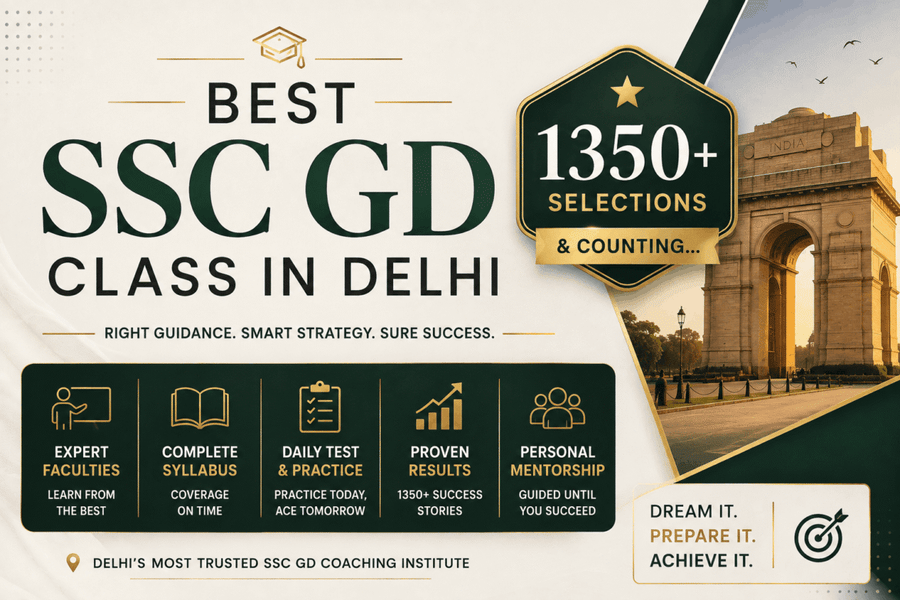
BEST BANK CLASS IN DELHI -1350+SELECTIONS

If you’re looking for one of the best bank coaching institutes in Delhi, DLC The Learning Club stands out as a top choice, particularly for its proven success and impressive track record of 1350+ selections. Here’s why it’s highly regarded:

Why DLC The Learning Club is the Best for Bank Coaching:

  1. Proven Track Record of Success:
    DLC has helped over 1350 students achieve success in bank exams, with a focus on practical strategies, exam patterns, and targeted preparation. The consistent results make it a trusted name for bank coaching in Delhi.
  2. Expert Faculty:
    Led by highly experienced instructors, the institute offers personalized guidance for each student, tailoring the coaching to individual needs. The faculty members are well-versed in the latest exam trends and provide expert tips to crack competitive bank exams.
  3. Comprehensive Study Material:
    The course comes with well-researched and up-to-date study materials, covering all subjects like quantitative aptitude, reasoning, English language, and general awareness, which are crucial for bank exams.
  4. Regular Mock Tests and Practice Sessions:
    To help students assess their preparation, regular mock tests and practice sessions are conducted. These simulate real exam conditions and help students build confidence.
  5. Stress-Free Learning Environment:
    The institute believes in creating a supportive and stress-free learning atmosphere, allowing students to learn at their own pace while staying motivated and focused on their goals.
  6. Banking Interview and GD Preparation:
    DLC also focuses on banking interviews and group discussions, preparing students for the entire selection process, not just the written exams.
  7. Affordable and Flexible Coaching:
    DLC offers flexible timings and affordable coaching options, making it accessible to a wide range of students aiming to crack competitive bank exams.

For students aspiring to join the banking sector, DLC The Learning Club offers the right blend of expert guidance, innovative teaching methods, and a proven track record of 1350+ selections in competitive exams. It’s one of the best choices for bank coaching in Delhi.

Vocabmetry

Vocabmetry is a unique and patented method developed by Rahul Parashar at DLC The Learning Club, designed to help students enhance their vocabulary in an efficient and engaging way. It’s a revolutionary approach that not only improves your word power but also ensures better retention and usage of new words in context.

Key Features of Vocabmetry:

  1. Contextual Learning:
    Unlike traditional methods that focus on rote memorization, Vocabmetry teaches words by placing them in real-life situations. This ensures that students understand how to use words correctly in sentences, making learning more practical and memorable.
  2. Effective Word Mapping:
    Vocabmetry employs a unique word-mapping technique that associates each word with its meaning, usage, and similar words, helping students grasp the word’s essence more naturally.
  3. Personalized Approach:
    The technique is adapted to each learner’s current level and pace. This personalized approach ensures that learners progress without feeling overwhelmed or underprepared.
  4. Engagement through Fun Methods:
    The method uses interactive exercises, storytelling, and visual aids, making vocabulary acquisition enjoyable. Students not only learn words but also retain them for longer periods.
  5. Boosts Communication:
    By increasing vocabulary and understanding word usage, Vocabmetry enhances communication skills, making students more confident and fluent in both writing and speaking.
  6. Scientific Method:
    Vocabmetry is based on research and data that show how people naturally learn and remember words, making it a scientifically grounded method for language improvement.

This innovative approach is one of the reasons DLC The Learning Club is recognized as one of the best institutes for Spoken English and competitive exam coaching. Whether you’re preparing for a public speaking event, interviews, or exams, Vocabmetry is the ideal tool to elevate your language proficiency.

 Patented Process

The patented process at DLC The Learning Club is a unique, scientifically designed method that sets it apart from other coaching institutes. Developed by Rahul Parashar, this method ensures that students not only learn but retain and apply the knowledge they gain in a way that’s more effective and engaging.

Key Features of the Patented Process:

  1. Innovative Learning Techniques:
    The patented process incorporates a variety of unique and creative teaching techniques like Vocabmetry, the Saas-Bahu concept for tenses, and the Haiwan concept for verbs. These methods simplify complex concepts, making them easy to understand and fun to learn.
  2. Comprehensive Approach:
    The process covers all aspects of language learning, from vocabulary and grammar to fluency and confidence building. It ensures holistic development, focusing not only on theoretical knowledge but also on practical communication skills.
  3. Personalized Attention:
    The process emphasizes individualized learning, ensuring that students receive personalized coaching that caters to their specific needs and learning pace. This guarantees faster and more efficient results.
  4. Result-Oriented:
    The patented process is designed with a focus on achieving real, measurable results. Whether it’s fluency in spoken English or success in competitive exams, students can see significant improvement in a short time.
  5. Stress-Free Learning:
    One of the highlights of the process is the emphasis on creating a comfortable, stress-free learning environment. Students feel at ease, which enhances their learning experience and helps them retain what they learn without pressure.
  6. Proven Track Record:
    The patented process has been tested and refined over time, leading to a high success rate and 1350+ selections of students in competitive exams. This track record speaks volumes about its effectiveness.

Overall, the patented process at DLC The Learning Club is an innovative and scientifically backed approach that helps students learn English and other skills in the most efficient and engaging way possible.

Coordinate based

The term “Coordinate-based” typically refers to an approach or system where learning or activities are structured based on specific coordinates or points of reference. In the context of DLC The Learning Club’s patented process or teaching methodology, this concept might relate to organizing learning in a structured, systematic way where students progress through various learning stages or checkpoints.

How “Coordinate-Based” Learning Could Apply at DLC The Learning Club:

  1. Structured Learning Stages:
    Just as coordinates map out specific points on a grid, the coordinate-based learning approach could be about dividing the course into specific, manageable milestones or stages. Each stage represents a key learning point or goal, helping students track their progress more effectively.
  2. Goal-Oriented Progression:
    Students move from one “coordinate” (learning checkpoint) to the next, ensuring that they gain a thorough understanding of foundational concepts before advancing. This helps maintain a steady progression rather than jumping ahead without mastering the basics.
  3. Personalized Learning Pathways:
    Every student can follow a customized path based on their current skills and needs, similar to how coordinates allow for specific destinations or locations to be reached. This ensures that the learning journey is both effective and efficient for each individual.
  4. Clear Benchmarks for Success:
    Like measuring distance between coordinates, the approach helps students see where they stand at various points in their learning journey. Clear benchmarks or assessments provide students with a sense of direction and a goal to work toward.
  5. Feedback Loops:
    Coordinating feedback and assessments throughout the learning process ensures that students receive regular insights into their strengths and areas for improvement, allowing them to adjust and optimize their learning based on these “coordinates.”

In sum, a coordinate-based learning system within the patented process at DLC The Learning Club would be about structured, goal-oriented learning that adapts to each student’s pace, ensuring they stay on track to achieve their objectives, whether in spoken English or any other subject.

Story- based and character -based

Incorporating story-based and character-based learning methods into the teaching process at DLC The Learning Club is a highly effective approach to make learning more engaging and relatable. By using stories and characters, students are able to connect emotionally with the content, making complex concepts easier to understand and remember.

Story-Based Learning:

  1. Relatable Contexts for Learning:
    Stories introduce real-life scenarios and situations that are relatable to the learners. For example, in learning tenses, students could follow the story of a character going on different adventures, with each adventure corresponding to a different tense (past, present, future). This makes grammar rules feel less abstract and more practical.
  2. Memory Retention:
    Humans are naturally wired to remember stories better than isolated facts or data. When new vocabulary, grammar, or concepts are presented in the form of a narrative, students can easily visualize and recall the information because it is embedded within a storyline they are following.
  3. Engagement and Motivation:
    A good story captures the interest of the learner and keeps them engaged, making them excited to move forward in the learning process. This creates a sense of anticipation, where students look forward to seeing how the story progresses and how it connects to their learning.

Character-Based Learning:

  1. Learning Through Characters:
    The use of characters helps make abstract concepts more tangible. For example, a character like “Haiwan” (used to teach the verb “have”) can make the learning of grammar rules fun and memorable. By associating each character with a particular skill, learners can easily associate the character with a specific lesson or concept.
  2. Personalized Learning:
    Each character could represent a particular learning style or approach. For example, a character who struggles with public speaking could illustrate how to overcome fear and improve confidence, while another character might represent someone who is great with vocabulary. This variety of characters helps meet different learning needs.
  3. Interactive Learning:
    When characters are involved in the process, students feel like they are on a journey with these characters, learning together. This interactive dynamic motivates learners to participate actively, ask questions, and engage in the learning process more deeply.

Example of How it Could Work:

  • Story Example:
    A learner could follow the story of a character named “Ravi”, who is preparing for a job interview. As Ravi practices his English, he encounters different language challenges, like using the correct tense, forming positive and negative sentences, and expanding his vocabulary. Each challenge Ravi faces helps reinforce the concepts being taught.
  • Character Example:
    The “Haiwan” character could represent possession (the verb “have”) and can be seen in various situations, such as having a house, strength, or experience. By learning alongside Haiwan, students can quickly internalize how the verb “have” is used in different contexts.

This story-based and character-based approach at DLC The Learning Club adds a fun and immersive layer to learning English and other skills, making the process exciting, relatable, and memorable for students.

Rahul Parashar

Rahul Parashar is the visionary founder and the driving force behind DLC The Learning Club. He is the creator of the Vocabmetry method and the patented processes that set the institute apart from traditional coaching methods. His expertise and innovative approach have made him a highly respected name in the field of spoken English and competitive exam coaching.

Key Contributions of Rahul Parashar:

  1. Creator of Vocabmetry:
    Rahul Parashar developed Vocabmetry, a groundbreaking method for learning and mastering vocabulary in a contextual and engaging way. This unique technique has helped thousands of students build a strong word bank and use words effectively in communication.
  2. Patented Teaching Process:
    Rahul’s patented process combines scientific research with practical teaching techniques to ensure that students not only learn but also retain and apply their knowledge. His approach focuses on personalized coaching, structured learning, and result-oriented techniques, leading to consistent success for students.
  3. Expert in Language Learning and Public Speaking:
    With years of experience, Rahul has become an expert in training students to improve their spoken English and develop public speaking skills. His coaching extends beyond just language proficiency, helping students build the confidence to speak in front of others and excel in competitive exams.
  4. Innovative Learning Methods:
    Rahul has introduced creative methods such as the Saas-Bahu concept for tenses and the Haiwan concept for verbs, making grammar and language learning both fun and effective.
  5. Focus on Results:
    Rahul Parashar’s goal is to ensure 100% results for his students. His methods have led to numerous success stories with over 1350+ selections in competitive exams and countless students mastering spoken English.

Conclusion

In conclusion, DLC The Learning Club, led by the visionary Rahul Parashar, stands out as one of the most innovative and result-oriented institutes for spoken English and competitive exam coaching in Delhi. With over 1350+ selections and a track record of success, the institute is a trusted name for students looking to enhance their language skills and achieve excellence in exams. The patented processes, Vocabmetry, and creative methods like the Saas-Bahu and Haiwan concepts make learning engaging, efficient, and fun. By focusing on a personalized approach and creating a stress-free learning environment, DLC ensures that every student receives the attention and guidance they need to succeed. Whether you’re looking to master spoken English, build confidence in public speaking, or prepare for competitive exams, DLC The Learning Club offers a comprehensive, proven solution that guarantees 100% results. If you’re committed to improving your skills and achieving your goals, DLC is the ideal place to start your learning journey.

FAQ (Frequently Asked Questions)

  1. What is the duration of the Spoken English course at DLC The Learning Club?
    The course is designed to show significant progress in 45 days, focusing on fluency, grammar, vocabulary, and public speaking.
  2. What makes DLC The Learning Club different from other institutes?
    DLC stands out because of its unique, patented teaching processes like Vocabmetry, the Saas-Bahu concept for tenses, and the Haiwan concept for verbs, all of which make learning more engaging and effective. The institute also emphasizes stress-free learning and personalized coaching.
  3. Do I need prior knowledge of English to join the course?
    No, the course is designed for learners of all levels—whether you’re a beginner or looking to refine your skills. The lessons are tailored to meet your specific needs.
  4. How quickly will I see results?
    With consistent effort, you will see visible results in just 45 days, including increased fluency, vocabulary, and confidence in speaking.
  5. What kind of support will I receive during the course?
    Students receive personalized attention through interactive lessons, mock tests, and feedback from experienced mentors. Regular progress tracking ensures that you’re always on the right path.
  6. Are there any specific materials provided during the course?
    Yes, you will receive study materials, including interactive lessons, quizzes, and practice exercises to help reinforce what you’ve learned.
  7. Can I learn public speaking along with spoken English?
    Yes, the course is designed not only to improve your spoken English but also to help you build confidence as a public speaker, with a special focus on overcoming fear and delivering effective presentations.
  8. What is Vocabmetry, and how does it help?
    Vocabmetry is a patented method that focuses on contextual learning, making vocabulary easy to understand, retain, and apply in real-life conversations. It enhances vocabulary through fun and interactive techniques.
  9. Is the course suitable for people with busy schedules?
    Absolutely! The course is designed to be flexible, allowing you to learn at your own pace. The lessons are broken down into manageable chunks, making it easy to fit learning into a busy lifestyle.
  10. What are the fees for the course, and are there any payment options?
    For details on course fees and payment plans, it’s best to contact DLC directly or visit their center for a consultation. They offer flexible payment options to make the course accessible for everyone.
  11. Is there a guarantee of results?
    DLC The Learning Club guarantees 100% results if you follow the course and engage with the materials. The unique methods are designed to ensure your success, whether in spoken English or exams.
  12. How can I enroll in the course?
    You can easily enroll by visiting DLC The Learning Club’s website or contacting the center directly. They’ll guide you through the enrollment process and help you get started.
  13. What if I have doubts during the course?
    You can always reach out for clarifications and personalized support. The team is available to address any concerns and provide additional resources to help you understand the material better.
  14. Can I get a demo class before enrolling?
    Yes, DLC offers demo classes for prospective students. You can attend a trial session to get a feel for the teaching style and course content before committing.

Contact Info

 +91 8989780888, +91 8962290283, +91 8962390283, +91 8962090283

 info@dlcthelearningclub.in

 www.dlcthelearningclub.in

0 comment
0 FacebookTwitterPinterestEmail
BEST SSC GD CLASS IN DELHI - 1350+ SELECTIONS

BEST SSC GD CLASS IN DELHI – 1350+SELECTIONS 

DLC The Learning Club, led by Rahul Parashar, is a prominent SSC coaching center in Delhi, boasting over 1,350 successful selections. The institute employs innovative teaching methodologies, including a patented approach called Vocabmetry, which utilizes story-based and character-based learning to enhance vocabulary retention. This unique method has contributed to their impressive track record in SSC exam preparation.

Vocabmetry

Vocabmetry is a unique, patented method developed by Rahul Parashar to help students learn and retain English vocabulary more effectively. This method is used at DLC The Learning Club, which is located in Mukherjee Nagar, Delhi and specializes in spoken English and SSC exam preparation.

How Vocabmetry Works

  1. Story-Based Learning – Instead of rote memorization, words are embedded in engaging stories that make them easier to remember.
  2. Character Associations – Difficult words are linked to characters or situations, making recall faster and more natural.
  3. Visualization Techniques – Words are illustrated with mental images, helping learners retain meanings effortlessly.
  4. Interactive & Engaging – Instead of dry word lists, students actively engage with words through fun exercises.
  5. Quick Retention & Recall – This approach reduces the time needed to memorize and ensures long-term retention.

Who Benefits from Vocabmetry?

  • SSC & Banking Exam Aspirants – Helps in vocabulary-heavy sections like English comprehension.
  • Spoken English Learners – Improves fluency and confidence in speaking.
  • Competitive Exam Candidates – Useful for exams requiring strong English vocabulary.

Vocabmetry has played a key role in helping thousands of students succeed in exams and improve their English communication. 🚀

New Learning Methodology

If you’re looking for a new learning methodology, especially for spoken English and competitive exams, several innovative approaches can be explored. Here are some effective modern methodologies, including Vocabmetry and other advanced techniques:

1. Vocabmetry (Patented by Rahul Parashar)

  • Story-Based Learning – Words are embedded in engaging stories to enhance retention.
  • Character Associations – Linking words to characters/situations for better recall.
  • Visualization Techniques – Using mental images to remember meanings effortlessly.
  • Highly Engaging & Effective – Increases recall speed and accuracy for competitive exams.

2. Gamification-Based Learning

  • Uses quizzes, challenges, and rewards to make learning fun.
  • Apps like Duolingo use this method to teach languages.
  • Encourages active learning and motivation through point-based progress tracking.

3. Immersive Learning (AI & VR Integration)

  • Virtual reality (VR) environments for real-life conversations.
  • AI-powered chatbots for instant spoken English practice.
  • Helps learners experience real-time interactions without a classroom.

4. Neuro-Linguistic Programming (NLP) in Learning

  • Uses mental associations and patterns to enhance memory.
  • Helps students train their brains for better word retention.
  • Can improve confidence in public speaking and communication.

5. Microlearning & Nano Learning

  • Short, focused lessons (2–5 minutes each) for fast learning.
  • Helps students retain information better than long lectures.
  • Ideal for busy learners who need quick revisions.

6. Active Recall & Spaced Repetition (SRS)

  • Scientific learning technique that enhances long-term retention.
  • Repeating learned material at strategic intervals boosts memory.
  • Anki, Quizlet, and other apps use this method.

7. Social & Collaborative Learning

  • Group discussions, debates, and peer learning.
  • Enhances real-world communication skills.
  • Encourages confidence-building in spoken English.

Story based and Character based Program

A story-based, character-based learning methodology is one of the most engaging and effective ways to help students retain information, especially in subjects like English vocabulary, spoken English, and competitive exam preparation. Vocabmetry, the patented method by Rahul Parashar, is an excellent example of this approach.

How Does Story-Based, Character-Based Learning Work?

Instead of memorizing words or concepts mechanically, students learn through stories where characters interact with the concepts. This makes learning fun, engaging, and memorable.

Key Features of This Methodology:

1. Story-Based Learning 📖

  • Words, concepts, or grammar rules are woven into engaging stories.
  • When students recall the storyline, they automatically remember the words.
  • Example: Instead of just memorizing “benevolent” (meaning kind-hearted), a story about “Benevolent Ben” who always helps people makes it stick.

2. Character-Based Learning 🎭

  • Difficult words or abstract ideas are linked to memorable characters.
  • Characters have personality traits matching the meaning of the word.
  • Example:
    • “Gregarious Greg” → A character who loves socializing (Gregarious = outgoing, social).
    • “Lethargic Larry” → A lazy character who always feels sleepy (Lethargic = lacking energy).

3. Visualization & Emotional Connection 🎨

  • When we see or feel something, we remember it longer.
  • A story with a twist, humor, or emotion strengthens memory recall.
  • Example: Instead of just memorizing “procrastinate” (delay tasks), imagine “Procrastinating Paul” who always postpones everything and gets into trouble!

4.Active Learning & Role Play 🎭

  • Students act out or narrate the stories in class.
  • Role-playing characters helps in spoken English fluency.
  • Example: In an English class, students take turns acting out “Gregarious Greg” at a party vs. “Lethargic Larry” refusing to dance.

Benefits of Story & Character-Based Learning 🚀

✔ Fast Recall – The brain remembers stories better than plain text.
✔ Fun & Engaging – Learning feels like a movie instead of a textbook.
✔ Long-Term Retention – Stories stick longer in memory.
✔ Confidence Boost – Helps students speak fluently & naturally.
✔ Best for Competitive Exams – Retaining difficult vocabulary becomes easy.

Where is This Method Used?

DLC The Learning Club – Uses Vocabmetry (story-based & character-based) for spoken English & SSC exam prep.
Language Learning Apps – Like Duolingo, Memrise, and FluentU.
Corporate Training & Soft Skills – Used in professional public speaking & leadership training.

How to Memorize Difficult Words Easily 🚀

Memorizing difficult words doesn’t have to be boring! With story-based, character-based, and visualization techniques, you can retain words faster and never forget them. Here’s a step-by-step guide using the Vocabmetry approach and other powerful memory techniques.

1.Story-Based Learning 

Example Word: “Ubiquitous” (Present Everywhere)

Instead of memorizing “ubiquitous” directly, create a short story:
“Imagine a magical cat named Ubi, who appears everywhere you go. You open your fridge – Ubi is there! You go to school – Ubi is on your desk! Ubiquitous means something that is present everywhere, just like Ubi the cat.”

Why it works? Your brain connects the word to a story & emotion, making it easier to recall.

2. Character-Based Learning 

Example Word: “Obstinate” (Stubborn)

Instead of cramming the definition, assign it to a character:
“Meet Obstinate Oliver – he refuses to change his mind about anything! Even if it’s raining, he won’t carry an umbrella. Even if he’s lost, he won’t ask for directions!”

Why it works? You’ll always remember “Obstinate Oliver” as the stubborn guy, making “obstinate” stick in your memory.

️3. Visualization Technique 

Example Word: “Ephemeral” (Lasting a Short Time)

Imagine a magical butterfly that appears for just a few seconds and then disappears into thin air. That’s ephemeral – something that lasts for a very short time.

Why it works? The brain remembers images better than text!

4. Mnemonics & Word Associations 

  • Meticulous (Very Careful) → Imagine “Moti-Killer” (a chef so careful that he never lets any dust fall in food).
  • Belligerent (Aggressive, War-like) → Think of a “bully” starting a fight.
  • Gregarious (Social, Friendly) → “Greg” loves to greet and talk to everyone.

Why it works? Mnemonics help by linking new words to familiar sounds.

5 Spaced Repetition (SRS)

  • Use apps like Anki or Quizlet to review words at strategic intervals.
  • The more often you recall a word, the stronger it sticks in your brain.

Why it works? Scientifically proven to boost long-term retention.

6 Active Usage in Daily Life ️

  • Try to use 3-5 new words in a conversation daily.
  • Write short stories or sentences with them.
  • Example: Instead of just memorizing “Loquacious” (Talkative), say:
    🗣 “My friend Rahul is so loquacious, he never stops talking!”

Why it works? The more you use a word, the better you remember it.

 Recap: The Best Tricks to Memorize Difficult Words

Story-Based Learning – Link words to engaging stories.
Character-Based Learning – Assign words to funny characters.
Visualization – Picture vivid mental images.
Mnemonics & Associations – Use sounds & patterns to remember.
Spaced Repetition – Review at scientific intervals for long-term memory.
Daily Usage – Speak, write, and practice words every day!

Rahul Parashar

Rahul Parashar is the patent holder of the Vocabmetry method, a unique story-based and character-based approach to learning vocabulary effectively. He is associated with DLC The Learning Club, a well-known institute in Mukherjee Nagar, Delhi, specializing in spoken English coaching and SSC exam preparation.

Rahul Parashar’s Contributions

Invented Vocabmetry – A scientifically designed method that helps students memorize difficult words through stories, characters, and visualization.
Expert in Spoken English & Competitive Exam Prep – Trains students to master English fluency, vocabulary, and grammar for exams like SSC, Banking, and UPSC.
Mentored Thousands of Students – His techniques have helped 1,350+ students crack competitive exams.
Innovative Teaching Methods – Uses interactive learning, storytelling, and memory hacks to make learning fun and effective.

Conclusion

The Vocabmetry method, developed and patented by Rahul Parashar, represents a breakthrough in vocabulary learning. By integrating stories, characters, and visualization techniques, it makes memorization effortless and enjoyable. This innovative approach has already helped thousands of students excel in spoken English and competitive exams. As learning continues to evolve, Vocabmetry stands as a proven and effective methodology that enhances retention, comprehension, and application of language skills. 🚀

Here are some frequently asked questions (FAQ) related to Vocabmetry and DLC The Learning Club:

1. What is Vocabmetry?

Vocabmetry is a patented learning method developed by Rahul Parashar that helps students memorize difficult vocabulary through story-based and character-based learning techniques. It makes learning vocabulary engaging, memorable, and long-lasting.

2. How does Vocabmetry work?

Vocabmetry uses stories and characters to embed words and their meanings in a way that connects emotionally with students. Words are associated with visualizations and memorable scenarios, making them easier to recall during exams or in conversation.

3. What is the main benefit of Vocabmetry?

The main benefit of Vocabmetry is that it helps students retain vocabulary for a long time without feeling overwhelmed by traditional memorization methods. It creates strong mental associations that improve both recall speed and understanding.

4. Who can benefit from Vocabmetry?

Students preparing for competitive exams like SSC, Banking, and UPSC, as well as those wanting to improve their spoken English skills, can greatly benefit from Vocabmetry. It is designed to make difficult words easier to understand and remember for all learners.

5. How is Vocabmetry different from other vocabulary learning methods?

Unlike traditional methods that focus on rote memorization, Vocabmetry makes learning fun and interactive by using stories, characters, and visualization. This active learning approach makes words stick in your memory, enhancing both vocabulary retention and application.

6. Can I learn Vocabmetry online?

Yes, DLC The Learning Club offers both online and offline courses that incorporate the Vocabmetry method. You can access lessons, practice exercises, and more from the comfort of your home.

7. Who is Rahul Parashar?

Rahul Parashar is a renowned educator and the creator of the Vocabmetry method. He specializes in spoken English coaching and competitive exam preparation, helping students improve their language skills with his innovative teaching techniques.

8. How can I enroll in DLC The Learning Club?

You can enroll in DLC The Learning Club either through their website or by visiting the Mukherjee Nagar branch in Delhi. They offer a variety of courses designed to cater to both beginner and advanced learners.

9. Is Vocabmetry suitable for non-English speakers?

Absolutely! Vocabmetry is designed for learners of all levels, including non-English speakers. It makes learning English vocabulary accessible and fun, even for beginners.

10. What kind of results can I expect from learning Vocabmetry?

Students who adopt the Vocabmetry method typically experience improved vocabulary retention, better exam performance, and enhanced spoken communication. Many students report a boost in confidence and language fluency.

Contact Info

 +91 8989780888, +91 8962290283, +91 8962390283, +91 8962090283

 info@dlcthelearningclub.in

 www.dlcthelearningclub.in

0 comment
0 FacebookTwitterPinterestEmail
Speed Dictionary
Speed Dictionary Offer!
Improve your vocabulary using our powerful Speed Learning Method.
Original Price

₹2000

Offer Price
₹1195

Buy Now - ₹1195/-

✔ Free Home Delivery | ✔ 24/7 Support

This will close in 70 seconds