Author

Abdul Cizen Siddiqui

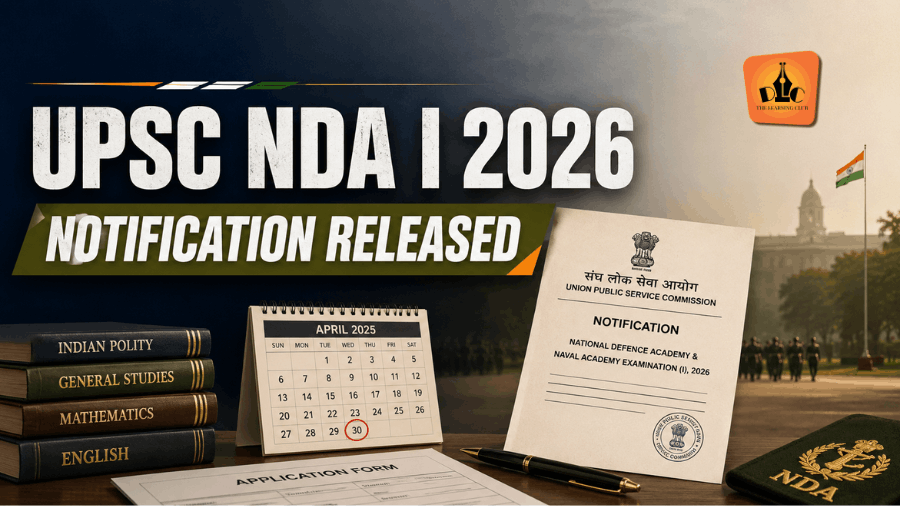
The Union Public Service Commission (UPSC) has officially released the NDA and Naval Academy (NA) Examination (I) 2026 notification. Candidates aspiring to join the Army, Navy, Air Force, or Naval Academy can now apply online through the official websites upsc.gov.in and upsconline.nic.in.

The application process began on December 10, 2025, and will remain open until December 30, 2025 (06:00 PM). A total of 394 vacancies have been announced for recruitment to the rank of Lieutenant under the 10+2 Cadet Entry Scheme.

UPSC NDA I 2026: Overview

  • Exam Name: NDA & NA Examination (I) 2026

  • Conducting Authority: Union Public Service Commission (UPSC)

  • Application Mode: Online

  • Total Vacancies: 394

  • Exam Date: April 12, 2026

I want to prepare for the examination.


UPSC NDA I 2026 Vacancy Details

The commission has released branch-wise vacancy details across all wings. The complete distribution is as follows:

Wing / Category Vacancies
Army 208
Navy (Executive Branch) 42
Air Force – Flying 92
Air Force – Ground Duties (Technical) 18
Air Force – Ground Duties (Non-Technical) 10
Naval Academy (10+2 Cadet Entry Scheme – Executive Branch) 24
Total 394

Important Dates: NDA I 2026

  • Notification Release Date: December 10, 2025

  • Application Start Date: December 10, 2025

  • Last Date to Apply: December 30, 2025 (till 06:00 PM)

  • Written Examination Date: April 12, 2026


Eligibility Criteria for UPSC NDA I 2026

Age Limit

  • Candidates must be unmarried male or female

  • Date of birth should be between July 1, 2007 and July 1, 2010

Educational Qualification

  • Applicants must meet the educational requirements prescribed for the respective wings of the NDA and NA as mentioned in the official notification.

Physical Standards

  • Candidates must fulfill the physical and medical standards specified by UPSC for Army, Navy, Air Force, and Naval Academy entries.


Application Fee Details

  • Rs.100/- for General, OBC, and EWS candidates

  • No fee for SC, ST, female candidates, and wards of JCOs, NCOs, and ORs

  • Fee payment is to be made online only


How to Apply Online for UPSC NDA I 2026

Follow the steps below to complete the application process:

  1. Visit the official website upsc.gov.in

  2. Open the NDA & NA I 2026 notification link

  3. Click on the online application portal, which redirects to upsconline.nic.in

  4. Complete registration with personal and contact details

  5. Fill in the application form, upload required documents, and pay the fee (if applicable)

  6. Submit the form and download the confirmation page for future reference

I want to prepare for the examination.


Selection Process for UPSC NDA I 2026

The selection process consists of multiple stages:

  1. Written Examination

  2. SSB Interview

  3. Document Verification

  4. Medical Examination

Candidates who clear the written examination will be shortlisted for the Service Selection Board (SSB) interview, conducted by the respective defence boards.


Important Links


Final Note

The release of the UPSC NDA I 2026 notification marks an important opportunity for defence aspirants aiming to serve the nation. Candidates are advised to carefully read the official notification, verify eligibility, and complete the application process well before the deadline to avoid last-minute issues.
I want to prepare for the examination.

0 comment
0 FacebookTwitterPinterestEmail
jee-main-2026-date-registration-and-updates

Session 1: 21–30 January 2026 | Session 2: 1–10 April 2026

Quick facts compiled from official NTA notifications and public information bulletins. Check the official portal: jeemain.nta.nic.in 

Quick headline facts (must-know)

  • Session 1 exam window: 21–30 January 2026.
  • Session 2 exam window: 1–10 April 2026.
  • Registration: Session 1 registration opened end-October 2025 (form live on the NTA site). Apply within the announced window.
  • Mode: Computer Based Test (CBT) for most papers (check official brochure for special tasks like B.Arch drawing requirements).

Note: All date claims and scheduling details are taken from NTA notifications and the official JEE(Main) portal — always verify on jeemain.nta.nic.in before acting.


What changed / what’s new for 2026 (short)

NTA published a formal advisory and information bulletin confirming two sessions in 2026 (January & April), with published application timelines and exam structure. Coaching portals and education sites summarized registration windows, correction-window dates and increased test city coverage — but always cross-check any summary with the official NTA bulletin.


Complete timeline checklist (actionable — copy this)

  1. Register promptly: Create a profile and register on the official portal (jeemain.nta.nic.in) as soon as the registration window opens.
  2. Submit application + fee: Complete the form and fee payment during the published window (Session 1 window was announced Oct–Nov 2025 for this cycle).
  3. Watch correction window: NTA often opens a short correction window — act fast if you need to correct data.
  4. City intimation / mock tests / admit card: Download city intimation and the admit card only from the official site when released; take provided mock tests to familiarise with CBT format.
  5. Exam day rules: Reach the centre early, carry ID proof and follow the centre instructions. External calculators are usually not allowed — follow the NTA instructions about virtual calculators.
  6. Answer key & result: NTA releases provisional answer keys, accepts challenges for a short window, and later publishes final results.


Exam pattern & important pointers (concise)

Papers: Paper 1 (B.E./B.Tech), Paper 2A (B.Arch), Paper 2B (B.Planning). Most parts are CBT. Confirm distribution and Section A/B rules in the official brochure.

Tip: Always download and read the latest NTA information bulletin to confirm Section-wise question counts, negative marking (if any) and allowed materials.

I want to prepare for examination.


JEE Main 2026 — Syllabus overview

Syllabus largely follows Class 11 & 12 NCERT topics for Physics, Chemistry & Mathematics. Below is a condensed, high-utility breakdown to help planning and revision.


Physics — Key topic areas

Area Typical chapters / concepts
Mechanics & Motion Physical World & Measurement; Kinematics; Laws of Motion; Work, Energy & Power; Rotational Motion; Gravitation; Properties of Solids & Liquids
Thermodynamics & Heat Thermodynamics; Kinetic Theory of Gases; Properties of Matter
Waves & Oscillations Oscillations; Waves
Electricity & Magnetism Electrostatics; Current Electricity; Magnetism & Magnetic Effects of Current; Electromagnetic Induction; AC; EM Waves
Optics & Modern Physics Optics; Dual Nature of Matter; Atoms & Nuclei; Electronic Devices
Practical / Experimental Measurement techniques; experiments with circuits, pendulum, optics, etc.

Chemistry — Key topic areas

  • Physical Chemistry: Basic Concepts, Atomic Structure, Chemical Bonding, Thermodynamics & Kinetics, Equilibrium, Electrochemistry.
  • Inorganic Chemistry: Periodicity, p/d/f block elements, coordination compounds, molecular structure.
  • Organic Chemistry: Fundamentals, hydrocarbons, halogens, oxygen/nitrogen compounds, functional groups, reaction mechanisms, biomolecules.


Mathematics — Key topic areas

  • Sets, Relations & Functions; Complex Numbers; Quadratic Equations
  • Matrices & Determinants; Permutations & Combinations; Binomial Theorem; Sequences & Series
  • Limits, Continuity & Differentiability; Integral & Differential Calculus
  • Coordinate Geometry (2D & 3D), Vector Algebra; 3D Geometry; Trigonometry; Statistics & Probability


How to use the two-session system to your advantage (prep strategy)

  • Plan two peaks: Treat Session-1 (Jan) as your first high-intensity attempt. Use feedback to improve for Session-2 (Apr).
  • Mock + analyse: After every mock, record mistakes in a “fault diary” and prioritise the top 20% topics that cause 80% of errors.
  • Revision windows: Build a January revision list (formula sheet, 50 most common problems). For April, design a remedial plan that targets weaker chapters plus timed full tests.
  • Admit card & test centre: Preview test centre route one week earlier; keep ID and backup printouts ready.


FAQ (short)

Q: Are dates final?
A: NTA published the schedule in its advisory and information bulletin; treat the NTA site and its PDFs as primary sources. If NTA revises dates, the revised schedule supersedes other reporting.
Q: When will admit cards be released?
A: NTA releases admit cards closer to each session. Download admit card and city intimation only from the official portal.
Q: Can I appear in both sessions?
A: Yes — candidates may appear in one or both sessions. Check eligibility & fee rules in the official NTA brochure.

I want to prepare for examination.


0 comment
0 FacebookTwitterPinterestEmail

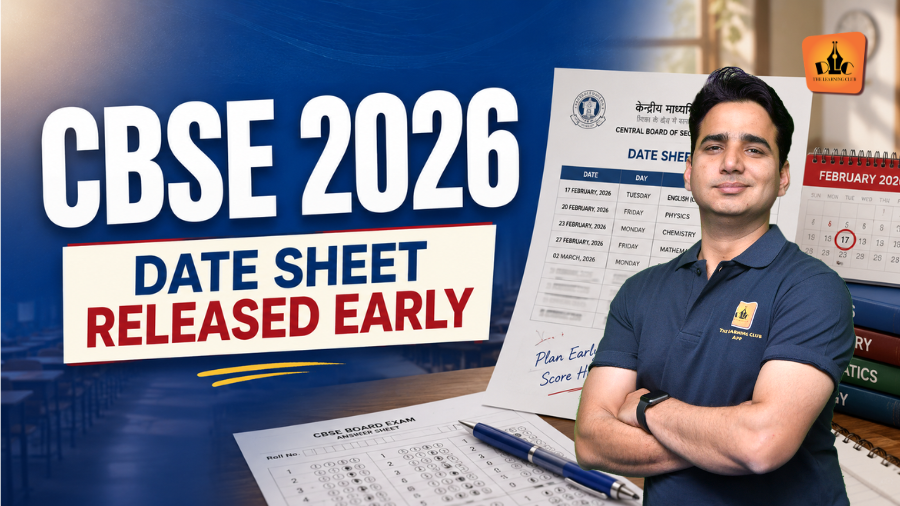
The Central Board of Secondary Education (CBSE) has surprised students nationwide by releasing the CBSE 2026 Date Sheet much earlier than expected. This early announcement has created a huge buzz among Class 10 and Class 12 students—mainly because it gives them extra time to plan, revise, and focus on scoring higher.

Here’s the complete CBSE 2026 date sheet, what it means for you, and how to use it to maximize your marks.
CBSE 2026 DATE SHEET (FULL & FINAL) –

For Class 10 and Class 12 – Verified, Latest, Final

CBSE Class 10 Date Sheet 2026:

Main Exam Period – 17 February 2026 – 10 March 2026
Second Attempt Window (NEP) – 15 May – 1 June 2026

Complete Class 10 Schedule:

Date Day Subject
17 Feb 2026 Tuesday Mathematics (Standard / Basic)
18 Feb 2026 Wednesday Home Science / Electives
20 Feb 2026 Friday Vocational Subjects (Marketing, IT, Beauty & Wellness, Multimedia, etc.)
21 Feb 2026 Saturday English (Communicative / Lang & Lit)
23 Feb 2026 Monday Regional Languages (Urdu / Tamil / Bengali / Punjabi / Marathi / etc.)
25 Feb 2026 Wednesday Science
26 Feb 2026 Thursday Vocational / Elective Papers
27 Feb 2026 Friday Computer Applications / Information Technology
02 Mar 2026 Monday Hindi (Course A / Course B)
07 Mar 2026 Saturday Social Science
10 Mar 2026 Tuesday French / Foreign Languages / Remaining Electives
Exam Timing: 10:30 AM onwards
Paper Duration: 2–3 hours depending on subject
CBSE Class 12 Date Sheet 2026 (Science, Commerce, Arts):
Main Exam Period – 17 February 2026 – 9 April 2026
Complete Class 12 Schedule:
Date Subject(s)
17 Feb 2026 Minor Subjects / Vocational / Electives
18 Feb 2026 Physical Education
19 Feb 2026 Entrepreneurship / Creative Writing / Electives
20 Feb 2026 Physics
28 Feb 2026 Chemistry
09 Mar 2026 Mathematics / Applied Maths
12 Mar 2026 English Core
14–25 Mar 2026 Humanities Subjects
20–28 Mar 2026 Commerce Subjects
27 Mar 2026 Biology
01–09 Apr 2026 Remaining Vocational & Language Papers
Exam Timing: 10:30 AM – 1:30 PM (varies by paper)
Download CBSE 2026 Date Sheet (PDF):

CBSE has never before released the date sheet this early. Here’s what it means:

⏰ More time for revision –
You can now plan chapter-wise revision systematically with extra preparation days.
😌Reduced exam stress –
No last-minute surprises. You already know your subject flow and can prepare accordingly.
🎯 Entrance exam planning becomes easier –
Important for JEE, NEET, CUET, CLAT, NDA, and other competitive exams.
🏫Schools can schedule pre-boards better –
Pre-boards, revisions, and model paper exams become more structured and effective.
What You Should Do NOW (Toppers’ Strategy):
Make a reverse-timeline plan –
Start from the last exam and plan backward to cover all subjects systematically.
Finish NCERTs first –
Especially for Science, Maths, History, Geography, Economics, and English.
Use the “High-to-Low Weightage Rule” –
Finish high-weightage chapters first to maximize scoring potential.
Give weekly mock tests –
Simulate real exam timing: 10:30 AM to 1:30 PM for perfect practice.
Practice previous years’ papers (last 5 years) –
CBSE repeats patterns and question styles. Master them for sure success.

I want to prepare for the examination!

Stay updated with official announcements and make the most of this early date sheet release!

0 comment
0 FacebookTwitterPinterestEmail

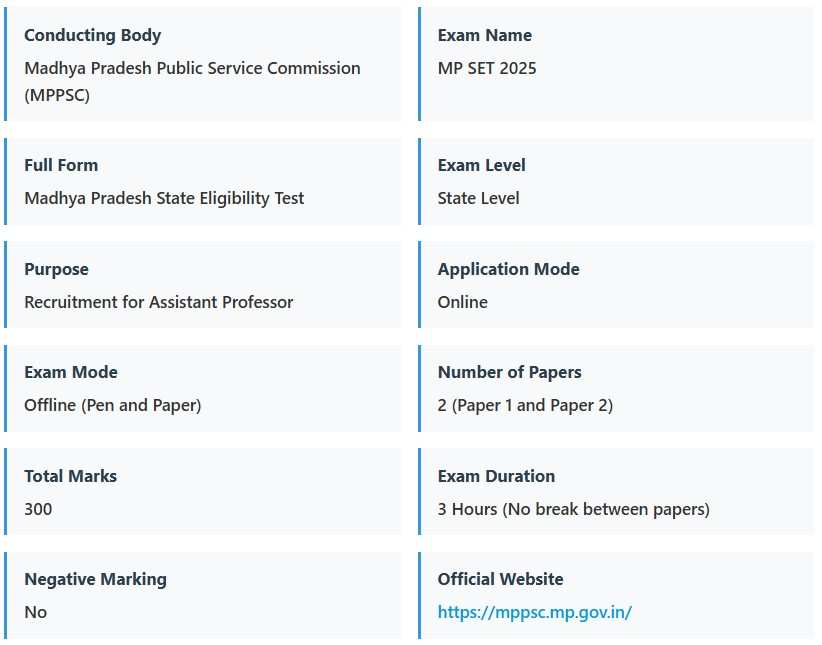
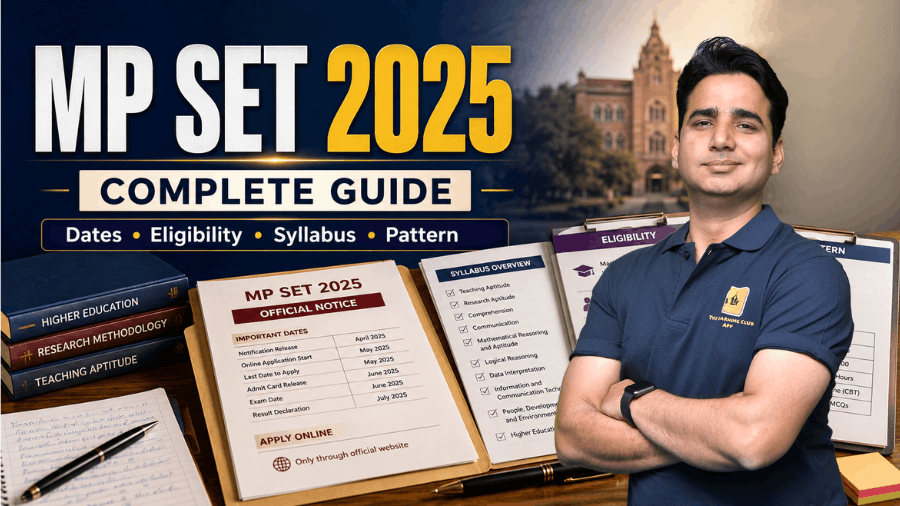
The Madhya Pradesh Public Service Commission (MPPSC) has officially announced the Madhya Pradesh State Eligibility Test (MP SET) for 2025. This examination serves as a gateway for aspiring candidates seeking the role of Assistant Professor in various universities and colleges across the state.

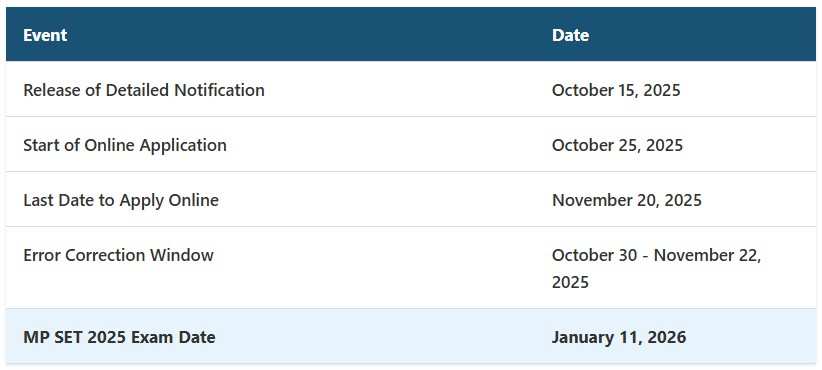
Official Notification: Released on October 15, 2025 on the commission’s websites: www.mponline.gov.in and www.mppsc.mp.gov.in.

Prospective applicants can begin their registration process from October 25, 2025. This comprehensive guide provides all the essential details you need to know about the MP SET 2025, including key dates, eligibility, application process, exam pattern, and syllabus.


MP SET 2025: Key Highlights at a Glance:
MP SET 2025: Key Highlights at a Glance


MP SET 2025 Important Dates

Candidates must mark their calendars with the following crucial deadlines:
MP SET 2025 Important Dates


MP SET 2025 Eligibility Criteria

Before applying, candidates must ensure they meet the following eligibility conditions:

1. Educational Qualification

  • Must possess a Postgraduate degree (e.g., MA, M.Sc, M.Com, etc.) from a university recognized by the UGC.
  • Candidates in the final year of their Postgraduation are also eligible to apply.
  • Minimum Marks Requirement:
    • General / OBC (Creamy Layer) / EWS: Must secure a minimum of 55% marks in their Postgraduation.
    • SC / ST / OBC (Non-Creamy Layer) / PwD (Domiciled in MP): Must secure a minimum of 50% marks.
  • Final-year students must obtain the required percentage within two years of the MP SET result declaration.
  • Ph.D. degree holders who completed their Master’s degree before September 19, 1991, are eligible for a 5% marks relaxation.
  • Candidates with foreign degrees must obtain an equivalence certificate from the Association of Indian Universities (AIU).

2. Age Limit

There is no upper age limit to appear for the MP SET 2025 exam. Candidates of any age can apply.


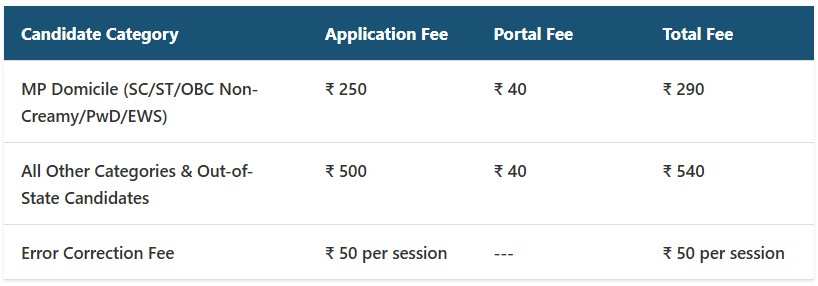
MP SET 2025 Application Fee

The application fee must be paid online via Net Banking, Credit Card, or Debit Card. The fee structure is as follows:
MP SET 2025 Application Fee


MP SET 2025 Exam Pattern & Syllabus

Understanding the exam structure is crucial for effective preparation.

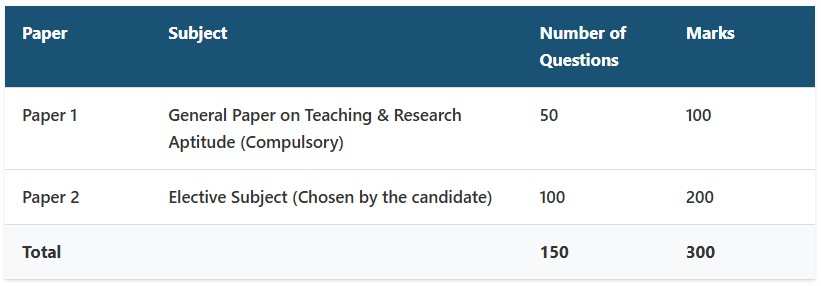
Exam Pattern

  • Mode: Offline (OMR Sheet Based)
  • Type of Questions: Objective Multiple Choice Questions (MCQs), Matching, True/False, Assertion-Reasoning.
  • Duration: 3 hours for both papers without any break.
    MP SET 2025 Exam Pattern & Syllabus


I want to prepare for the examination!


Syllabus for Paper 1

Paper 1 is designed to assess teaching and research aptitude. It is common for all candidates and tests their general awareness about teaching, research, reasoning ability, comprehension, and divergent thinking.

The paper consists of 50 multiple-choice questions (MCQs) with each question carrying 2 marks, making the total marks 100.

Teaching Aptitude
  • Teaching: Concept, Objectives, Levels of teaching
  • Learner’s characteristics
  • Factors affecting teaching
  • Methods of teaching in higher education
  • Teaching Support System
  • Evaluation Systems
Research Aptitude
  • Research: Meaning, Types, and Characteristics
  • Methods of Research
  • Steps of Research
  • Thesis and Article writing
  • Application of ICT in research
  • Research ethics
Comprehension
  • A passage of text is given
  • Questions are asked from the passage to be answered
Communication
  • Communication: Meaning, types, and characteristics
  • Effective communication
  • Barriers to effective communication
  • Mass Media and Society
Mathematical Reasoning & Aptitude
  • Types of reasoning
  • Number series, Letter series, Codes, and Relationships
  • Mathematical Aptitude (Fraction, Time & Distance, etc.)
Logical Reasoning
  • Understanding the structure of arguments
  • Evaluating deductive and inductive reasoning
  • Venn diagram
  • Indian Logic: Means of knowledge
  • Pramanas and Structure of Anumana
Data Interpretation
  • Sources, acquisition, and classification of Data
  • Quantitative and Qualitative Data
  • Graphical representation and mapping of Data
  • Data Interpretation
  • Data and Governance
Information & Communication Tech.
  • ICT: General abbreviations and terminology
  • Basics of Internet, Intranet, E-mail
  • Digital initiatives in higher education
  • ICT and Governance
People, Development & Environment
  • Development and environment
  • Human and environment interaction
  • Environmental issues
  • Impacts of pollutants on human health
  • Natural and energy resources
  • Environmental laws and agreements
Higher Education System
  • Institutions of higher learning in ancient India
  • Evolution of higher learning in post-independence India
  • Learning programs in India
  • Professional and Skill-Based Education
  • Value education and environmental education
  • Policies, Governance, and Administration


Syllabus for Paper 2

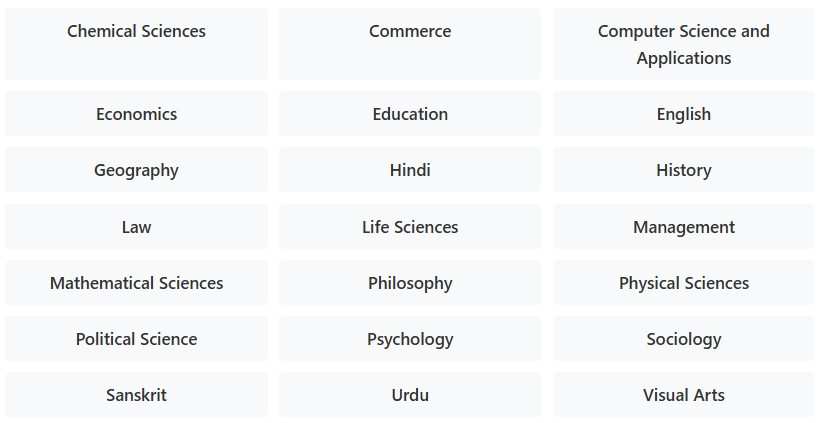
Paper 2 is based on the elective subject chosen by the candidate. The MP SET 2025 is conducted for a total of 31 subjects, including:
MP SET 2025 Exam Syllabus

(Candidates should refer to the official notification for the detailed syllabus of their chosen elective subject.)


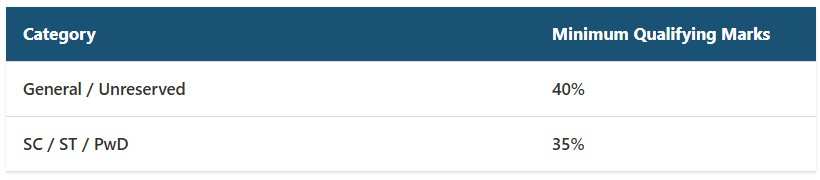
MP SET 2025 Minimum Qualifying Marks

To clear the exam, candidates must secure the following minimum aggregate marks:
MP SET 2025 Minimum Qualifying Marks

I want to prepare for the examination!


Conclusion:

The MP SET 2025 is a significant opportunity for those aiming to build a career in academia within Madhya Pradesh. Keep a close watch on the official MPPSC website for any updates and the release of admit cards closer to the exam date.

Best of luck with your preparations!
0 comment
0 FacebookTwitterPinterestEmail
SSC-CPO-Recruitment-2025

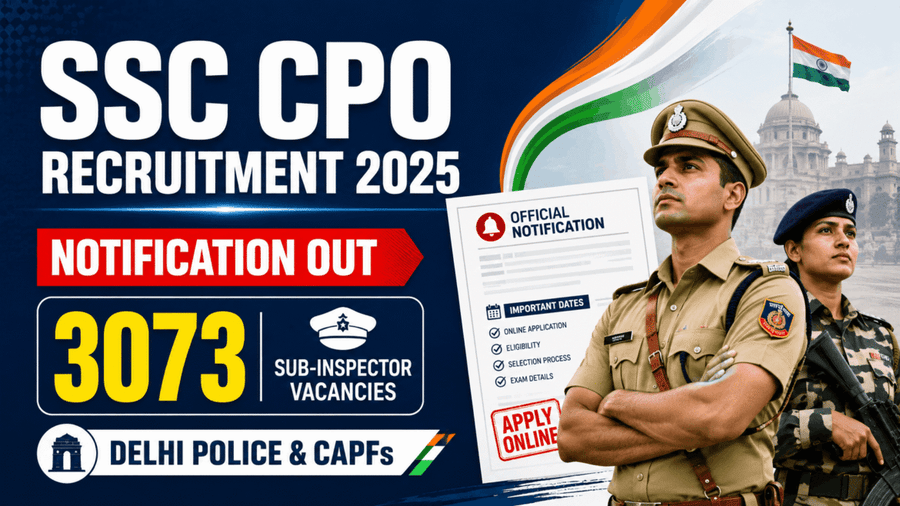
SSC CPO 2025 Recruitment: 3073 Sub-Inspector Vacancies

Important Update: Staff Selection Commission (SSC) has declared 3073 openings for Sub-Inspector (Executive) – Male/Female in Delhi Police and Sub-Inspector roles in Central Armed Police Forces (CAPFs). The online registration for the SSC CPO Exam began on 26th September 2025 through the official website https://ssc.gov.in/, along with the publication of the SSC CPO Notification 2025 PDF.

SSC CPO Recruitment 2025 Overview

The SSC CPO Exam is conducted by the Staff Selection Commission to appoint candidates as Sub-Inspectors in Delhi Police and CAPFs. The 2025 examination will be carried out in four phases – Paper I, Physical Standard/Endurance Tests (PST/PET), Paper II, and Detailed Medical Examination (DME). Candidates clearing all the stages will be considered for the posts of Sub-Inspector (Executive) in Delhi Police and Sub-Inspector (General Duty) in CAPFs.

Posts to be filled through SSC CPO 2025:

  • Sub-Inspector (Executive) in Delhi Police
  • Sub-Inspector (GD) in BSF
  • Sub-Inspector (GD) in CISF
  • Sub-Inspector (GD) in CRPF
  • Sub-Inspector (GD) in ITBP
  • Sub-Inspector (GD) in SSB

SSC CPO 2025 Notification

The official SSC CPO 2025 Notification was published on 26th September 2025 at www.ssc.gov.in. This recruitment drive invites applications for Sub-Inspector (SI) in Delhi Police and CAPFs, offering an excellent chance for graduates aspiring to secure a government role in the armed forces.

SSC CPO 2025 Exam Highlights

A total of 3073 vacancies will be filled for SI positions through this recruitment. The selection stages include Paper 1, PET/PST, and Paper 2.

Parameter Details
Conducting Body Staff Selection Commission (SSC)
Posts SI (Executive) in Delhi Police & SI (GD) in CAPFs
Vacancies 3073
Category Govt Jobs
Application Dates 26th September – 16th October 2025
Selection Process Paper 1 → PET/PST → Paper 2
Pay Scale ₹35,400 – ₹1,12,400
Job Location Delhi (for Delhi Police)
All India for other Forces
Official Website https://ssc.gov.in

SSC CPO 2025 Key Dates

Event Date
Notification Release 26th September 2025
Online Applications Open 26th September 2025
Last Date to Apply 16th October 2025 (till 11 PM)
Fee Payment (Online) 17th October 2025 (till 11 PM)
Application Correction Window 24th – 26th October 2025
Admit Card To be announced
Paper I Exam November–December 2025

SSC CPO 2025 Vacancy

A total of 3073 posts are notified for Sub-Inspector (Executive) in Delhi Police and Sub-Inspector (GD) in CAPFs under the SSC CPO 2025 Exam. Post-wise and category-wise vacancy details are tabulated in the notification.

SSC CPO Online Application 2025

The application process began on 26th September 2025 at ssc.gov.in. Candidates must submit their forms online before 16th October 2025, as late applications will not be accepted.

SSC CPO 2025 Application Fee

  • Fee: ₹100 (for General/OBC male candidates)
  • Exempted Categories: Women, SC, ST, and Ex-Servicemen (eligible for reservation)
  • Mode of Payment: Online (Net Banking, Debit/Credit Cards, UPI, BHIM, etc.)

SSC CPO 2025 Eligibility

To apply, candidates must satisfy the following requirements:

1. Nationality

Must be an Indian citizen, or a subject of Nepal/Bhutan, with eligibility certification from Govt. of India (where required).

2. Educational Qualification

  • SI (GD) in Delhi Police & CAPFs: Bachelor’s Degree in any discipline.
  • SI (Executive) in Delhi Police – Male only: Must hold a valid LMV Driving License (car/motorcycle) at the time of PET/PST.

3. Age Limit (as of 01/08/2025)

  • Minimum: 20 years
  • Maximum: 25 years (Born between 02.08.2000 and 01.08.2005)
  • Relaxations: SC/ST (5 yrs), OBC (3 yrs), ESM (3 yrs after service), Widows/divorced women (up to 35 yrs, 40 yrs for SC/ST), Departmental candidates (up to 30–35 yrs depending on category).

SSC CPO 2025 Selection Process

Recruitment will follow four stages:

  1. Paper I (CBT)
  2. Physical Standard/Endurance Tests (PST/PET)
  3. Paper II (CBT – English Comprehension)
  4. Detailed Medical Examination (DME)

SSC CPO 2025 Exam Pattern

Both Paper I and II are Objective MCQ-based. Paper I is bilingual (English & Hindi), while Paper II is only in English. Negative Marking: 0.25 marks per wrong answer. Duration: 2 hours (sectional timing of 30 minutes each for Paper I).

Paper 1 Structure

Subject Questions Marks
Reasoning 50 50
GK/GA 50 50
Quantitative Aptitude 50 50
English Comprehension 50 50
Total 200 200 marks (2 hrs)

Paper 2 Structure

  • English Language & Comprehension – 200 Q / 200 M

SSC CPO 2025 Syllabus

Paper 1:

  • Reasoning: Verbal Reasoning, Syllogism, Puzzles, Coding-Decoding, Directions, etc.
  • GK: Current Affairs, Awards, Sports, Books, Scientific Research, etc.
  • Quantitative Aptitude: Percentage, Ratios, Mensuration, DI, Time/Work, Algebra, etc.
  • English: Reading Comprehension, Vocabulary, Grammar, Voice, Para Jumbles, etc.

Paper 2:

Focuses on English comprehension & language ability.

SSC CPO 2025 Salary

As per the 7th Pay Commission, Sub-Inspector posts carry a Level 6 Pay Scale with ₹35,400 – ₹1,12,400.

  • SI (Delhi Police): Group ‘C’, Non-Gazetted
  • SI (CAPFs): Group ‘B’, Non-Gazetted

SSC CPO 2025 Admit Card

Admit Cards for Paper I & II will be released separately on the SSC official website. Candidates will need their registration details to download them before the exam date.

SSC CPO 2025 Result

Results will be declared stage-wise on https://ssc.gov.in in PDF format, containing names and roll numbers of qualified candidates.

SSC CPO 2025 Preparation

To succeed, candidates should focus on Paper I & II subjects while also preparing for physical and medical tests.

Recommended Preparation Courses

For comprehensive preparation materials and courses, visit:

Explore Preparation Courses

0 comment
0 FacebookTwitterPinterestEmail
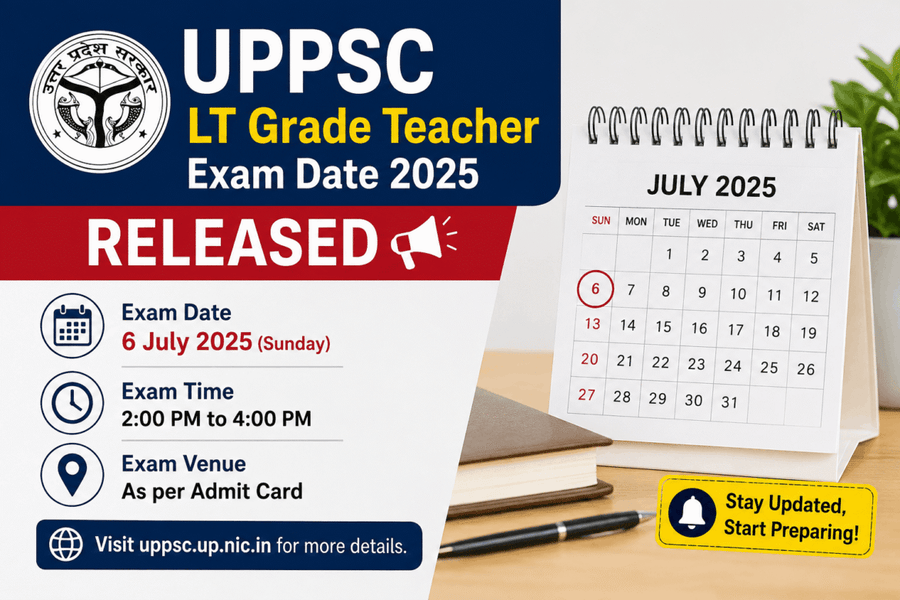
UPPSC LT Grade Teacher Exam Date 2025 Announced

UPPSC LT Grade Teacher Exam Date 2025 Announced – Admit Card to be Released Soon

The Uttar Pradesh Public Service Commission (UPPSC) has officially declared the exam schedule for the UP LT Grade Assistant Teacher Recruitment 2025. The announcement was made on 20th September 2025, confirming the recruitment drive for 7,466 Assistant Teacher posts.

As per the official notification, the written examinations for six subjects are scheduled to take place on 6th, 7th, and 21st December 2025. These exams will be conducted at various examination centers across Uttar Pradesh.

UPPSC LT Grade Teacher Exam 2025 – Official Notice Released

The Uttar Pradesh Public Service Commission (UPPSC) has published the official notice regarding the UPPSC LT Grade Assistant Teacher Exam Date 2025 on its website – uppsc.up.nic.in. For this recruitment drive, the commission has announced 7,466 vacancies for LT Grade Teachers.

As per the latest update, the written examination for subjects including Mathematics, Hindi, Science, Sanskrit, Home Science, and Commerce will be conducted on 6th, 7th, and 21st December 2025 across multiple centers in Uttar Pradesh.

The exam schedule for the remaining subjects will be declared separately by the commission in due course. Candidates are advised to keep visiting the official site for further updates.

UP LT Grade Teacher Vacancy 2025 – Overview

The UPPSC, a state government authority responsible for hiring candidates for various posts under the Government of Uttar Pradesh, has invited applications for Assistant Teacher positions.

Total Vacancies 7,466
Eligibility Graduation + B.Ed (along with other prescribed criteria)
Selection Process Candidates will be shortlisted based on their performance in the Preliminary Examination followed by the Mains Examination.

LT Grade Teacher Recruitment 2025 – Key Highlights

Conducting Authority Uttar Pradesh Public Service Commission (UPPSC)
Position Offered LT Grade (Licentiate Grade) Assistant Teacher
Total Vacancies 7,466
Application Mode Online Submission
Exam Dates 6th, 7th, and 21st December 2025
Selection Stages Preliminary Exam followed by Mains Exam
Age Criteria 21 to 40 years
Pay Scale ₹9,300 – ₹34,800 plus Grade Pay of ₹4,800
Job Posting Across Uttar Pradesh
Official Portal http://uppsc.up.nic.in/

UPPSC LT Grade Teacher Exam Date 2025 Released

The Assistant Teacher, Trained Graduate Grade (Male/Female Branch) Examination 2025 is scheduled to be conducted by UPPSC for six subjects – Mathematics, Hindi, Science, Sanskrit, Home Science, and Commerce. The exams will take place on 6th, 7th, and 21st December 2025.

The exam timetable for the remaining nine subjects will be announced later on the official website – uppsc.up.nic.in.

UPPSC LT Grade Teacher Exam 2025 – Subject-Wise Schedule

Subject Exam Date Exam Time
Mathematics 6th December 2025 09:00 AM – 11:00 AM
Hindi 6th December 2025 03:00 PM – 05:00 PM
Science 7th December 2025 09:00 AM – 11:00 AM
Sanskrit 7th December 2025 03:00 PM – 05:00 PM
Home Science 21st December 2025 09:00 AM – 11:00 AM
Commerce 21st December 2025 03:00 PM – 05:00 PM

UPPSC LT Grade Teacher Recruitment 2025 – Key Dates

The online application process for the UP LT Grade Teacher Recruitment 2025 has already been completed on the official website – uppsc.up.nic.in. The written examinations are scheduled for 6th, 7th, and 21st December 2025.

Candidates can go through the important dates related to the recruitment process in the table below:

Events Dates
Release of Detailed Notification 28th July 2025
Starting Date of Registration 28th July 2025
Closing Date of Registration 28th August 2025
Application Correction Window 4th September 2025
Examination Dates 6th, 7th, and 21st December 2025

UP LT Grade Teacher Vacancy 2025

For the UPPSC LT Grade Teacher Recruitment 2025, the commission has released a total of 7,466 vacancies. This recruitment drive offers a great opportunity for candidates aiming to build a career in the teaching sector.

Out of the total posts, 4,860 vacancies are reserved for male candidates, 2,525 for female candidates, and 81 for persons with disabilities (PwD).

Category Number of Vacancies
Male Candidates 4,860
Female Candidates 2,525
Persons with Disabilities (PwD) 81
Total 7,466

UP LT Grade Teacher Recruitment 2025 – Eligibility Criteria

Candidates who wish to apply for the UP LT Grade Teacher Vacancy 2025 must meet the prescribed eligibility conditions set by UPPSC. Applicants should have completed their graduation in the relevant subject along with a B.Ed. degree from an institution recognized by NCTE.

Educational Qualification for LT Grade Teacher

Subjects Required Qualification
Hindi (i) A Bachelor's degree with Hindi as a subject from a recognized University/Deemed University/Institution established under Indian law, along with Intermediate with Sanskrit as a subject. OR, a pass certificate in Uttar Madhyama Pariksha from UP Sanskrit Shiksha Parishad.

(ii) B.Ed. degree from an NCTE-recognized course in India.
English (i) A Bachelor's degree with English Literature as a subject from a recognized University/Deemed University/Institution established under Indian law.

(ii) B.Ed. degree from an NCTE-recognized course in India.
Mathematics (i) A Bachelor's degree with Mathematics as one of the subjects from a recognized University/Deemed University/Institution established under Indian law.

(ii) B.Ed. degree in a program recognized by NCTE in India.
Science (i) A Bachelor's degree with Physics and Chemistry as subjects from a recognized University/Deemed University/Institution established under Indian law.

(ii) B.Ed. degree in a program recognized by NCTE in India.
Social Science (i) A Bachelor's degree with at least two subjects from History, Geography, Political Science, or Economics from a recognized University/Deemed University/Institution established under Indian law.

(ii) B.Ed. degree in a program recognized by NCTE in India.
Computer (i) B.Tech./B.E. in Computer Science from a recognized University/Deemed University/Institution established under Indian law. OR Bachelor's degree in Computer Science. OR Bachelor's degree in Computer Applications. OR Any Graduation degree along with an 'A' Level certification from NIELIT. OR B.Tech in Computer Science along with MCA (Postgraduate in Computer Science).

(ii) B.Ed. degree from an NCTE-recognized program in India.
Urdu (i) A Bachelor's degree with Urdu as a subject from a recognized University/Deemed University/Institution established under Indian law.

(ii) B.Ed. degree from an NCTE-recognized course in India.
Biology (i) A Bachelor's degree with Zoology and Botany as subjects from a recognized University/Deemed University/Institution established under Indian law.

(ii) B.Ed. degree from an NCTE-recognized course in India.
Sanskrit (i) A Bachelor's degree with Sanskrit as a subject from a recognized University/Deemed University/Institution established under Indian law.

(ii) B.Ed. degree from an NCTE-approved course in India.
Arts (i) A Bachelor's degree in Arts from a recognized University/Deemed University/Institution established under Indian law.

(ii) B.Ed. degree from an NCTE-approved course in India.

OR

(i) Graduation in Fine Arts (BFA) from a recognized University/Deemed University/Institution established under Indian law.

(ii) Graduation in Education (B.Ed.) from a recognized University/Deemed University/Institution established under Indian law (considered as a preferential qualification).
Music (i) Bachelor's degree with Music as a subject from a recognized University/Deemed University/Institution established under Indian law.

OR

Sangeet Visharad from Bhatkhande Sangeet Mahavidyalaya or Sangeet Prabhakar from Prayag Sangeet Samiti, Allahabad, along with a Bachelor's degree from a recognized University/Deemed University/Institution established under Indian law.

Note: No quality points will be awarded for Sangeet Visharad or Sangeet Prabhakar. (ii) B.Ed. degree from an NCTE-recognized institution in India.
Commerce (i) Bachelor's degree in Commerce from a recognized University/Deemed University/Institution established under Indian law.

(ii) B.Ed. degree from an NCTE-recognized institution in India.
Physical Education (Male/Female) (i) Bachelor's degree from a recognized University/Deemed University/Institution established under Indian law.

(ii) B.P.Ed. or B.P.E. degree from an NCTE-approved institution in India.
Home Science (i) Bachelor's degree with Home Science as a subject from a recognized University in India.

(ii) B.Ed. degree from an NCTE-recognized institution in India.
Agriculture/Horticulture (i) Bachelor's degree in Agriculture or Horticulture from a recognized University in India.

(ii) B.Ed. degree from an NCTE-approved institution in India.

UP LT Grade Teacher Recruitment 2025 – Age Limit

As per the official notification, candidates applying for the UP LT Grade Teacher Recruitment 2025 must fall within the age bracket of 21 to 40 years as of 1st July 2025.

Eligible candidates should have been born between 2nd July 1985 and 1st July 2004.

Minimum Age 21 years
Maximum Age 40 years

UP LT Grade Teacher 2025 Selection Process

The Uttar Pradesh Public Service Commission (UPPSC) will follow a two-stage selection procedure to recruit candidates for the post of LT Grade Teacher (Licentiate Teacher) under the UP LT Grade Teacher Recruitment 2025.

Stage 1 – Preliminary Examination

The first step is a preliminary exam conducted by UPPSC. This test will act as a screening round to shortlist candidates for the mains examination.

Stage 2 – Mains Examination

Candidates who qualify in the prelims will be invited to appear for the mains exam. The mains paper will be descriptive in nature, carrying both short-answer and long-answer type questions, with a total weightage of 200 marks.

UPPSC LT Grade Teacher 2025 Exam Pattern

Understanding the exam pattern is crucial for effective preparation. The written test is structured as follows:

Prelims Exam Pattern

The exam will have a total of 150 questions carrying 150 marks.

It is divided into two sections:

  • General Studies – 30 questions
  • Subject-Specific (Concerned Subject) – 120 questions

The total duration of the paper will be 2 hours.

There will be negative marking of 0.33 marks for every wrong answer.

UP LT Grade Teacher 2025 Prelims Exam Pattern

Candidates appearing for the preliminary stage must keep the following details in mind:

Parameters Details
Number of Questions 150 (General Studies – 30, Subject Concerned – 120)
Total Marks 150
Type of Questions Objective, Multiple-Choice Questions (MCQs)
Marking Scheme +1 for every correct response
Negative Marking –0.33 marks for each incorrect answer
Exam Duration 2 hours

The prelims test checks both general awareness and subject knowledge, making it the first important hurdle for aspiring candidates.

UP LT Grade Teacher 2025 Mains Exam Pattern

Candidates who successfully clear the prelims will be called for the Mains Examination. Unlike the prelims, the mains exam will be descriptive in nature. It will include:

  • Short-answer type questions
  • Long-answer type questions

The descriptive nature of the mains ensures that candidates are evaluated not only on knowledge but also on their ability to explain, analyze, and write effectively.

UP LT Grade Teacher 2025 Mains Exam Pattern

The Mains Examination is descriptive in nature and is designed to test the candidate's subject expertise and writing ability.

Particulars Details
Type of Questions Descriptive (Subjective)
Total Sections 2
Section 1 Short Answer Questions
Section 2 Long Answer Questions
Total Questions 20 (10 short + 10 long)
Total Marks 200 (80 for short answers + 120 for long answers)
Duration 3 hours

UP LT Grade Teacher Salary 2025

Candidates appointed as LT Grade Teachers will receive an attractive salary package under the 7th Pay Commission.

Pay Scale ₹44,900 – ₹1,42,400
Grade Pay ₹4600
Pay Level Level 7
Allowances Dearness Allowance (DA), House Rent Allowance (HRA), and other admissible benefits

This makes the LT Grade Teacher post not only a secure government job but also a financially rewarding career option.

Post Name Salary
LT Grade Teacher ₹44,900 – ₹1,42,400/-
Grade Pay ₹4,600/-
Gross Pay ₹49,934/- (approx.)

UP LT Grade Teacher Job Profile 2025

The role of an LT Grade Teacher goes beyond teaching; it also includes nurturing students' academic growth and contributing to the school's overall progress.

Key Responsibilities:

  • Subject Teaching: Deliver quality teaching in subjects like Hindi, English, Mathematics, Science, Social Studies, Computer Science, and others as per specialization.
  • Student Assessment: Conduct exams, tests, and assignments to track student progress. Provide constructive feedback and offer additional support where needed.
  • Classroom Management: Maintain discipline, encourage active participation, and create a positive learning environment.
  • Record Maintenance: Keep accurate records of attendance, marks, and academic reports.
  • Collaboration: Work closely with fellow teachers, staff, and the school administration to ensure smooth implementation of study plans and academic objectives.

This job profile ensures a balance of teaching, administrative duties, and student mentoring, making it one of the most sought-after positions in the teaching sector.

0 comment
0 FacebookTwitterPinterestEmail

To score well in the SSC CHSL 2025 exam, candidates must have a clear understanding of the exam pattern and syllabus. Knowing the structure of the exam and the subject-wise topics is essential for effective preparation.

The SSC CHSL exam is conducted in two stages – Tier 1 and Tier 2.

I want to prepare for SSC CHSL 2025


SSC CHSL Syllabus 2025:

The Staff Selection Commission (SSC) has officially released the SSC CHSL Exam Pattern and Syllabus in its latest notification.

The SSC CHSL Tier 1 Exam 2025 is scheduled to be conducted from 8th to 18th September 2025.

In this article, we provide a detailed overview of the SSC CHSL 2025 Exam Pattern and Syllabus for both Tier 1 and Tier 2 examinations.

SSC CHSL 2025 Selection Process:

The SSC CHSL 2025 recruitment will be carried out in two main stages, and candidates must qualify at each stage to move forward in the selection.

SSC CHSL Syllabus 2025 for Tier-I Exam:

The SSC CHSL Tier- I Exam 2025 is the first stage of the selection process.

It is conducted in online mode (Computer-Based Test) and consists of four subjects:
English Language, Quantitative Aptitude, General Intelligence, and General Awareness.

SSC CHSL Tier-I Exam Pattern 2025:

  • The exam is conducted online (CBT).
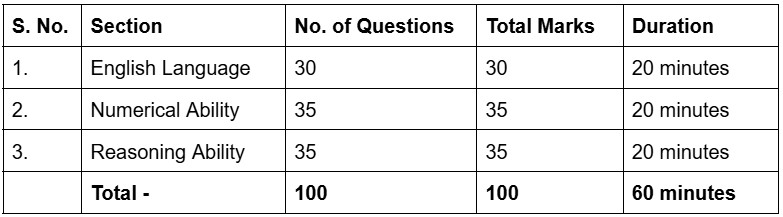
  • The paper contains 100 multiple-choice questions.
  • Each question carries 2 marks, making the exam worth a total of 200 marks.
  • The duration of the exam is 60 minutes (80 minutes for PwD candidates).
  • There is a negative marking of 0.5 marks for every wrong answer.

Total: 100 Questions | 200 Marks | 60 Minutes


SSC CHSL General Awareness Syllabus:

The General Awareness (GA) section checks a candidate’s understanding of the environment, current affairs, and day-to-day knowledge expected from an educated individual.

Key topics include:

  • History (Ancient, Medieval, Modern)
  • Indian Geography & Neighbouring Countries
  • Indian Polity & Constitution
  • Economy & Financial Awareness
  • Culture & Heritage
  • Current Affairs (National & International)
  • General Science & Scientific Research
  • Awards and Honors
  • Books and Authors
  • Sports GK
  • Indian GK (Important Events, National Symbols, Personalities, Schemes, etc.)
  • Government Policies & General Policy


SSC CHSL General Intelligence Syllabus:

The General Intelligence/Reasoning section includes both verbal and non-verbal reasoning.

Important topics include:

  • Analogies (Semantic, Symbolic, Figural)
  • Classification (Semantic, Symbolic, Figural)
  • Series (Number, Alphabet, Figural, Semantic)
  • Coding-Decoding
  • Venn Diagrams
  • Critical Thinking & Problem-Solving
  • Embedded Figures
  • Pattern Folding & Completion
  • Space Orientation & Visualization
  • Punched Hole Patterns
  • Word Building
  • Drawing Inferences
  • Emotional & Social Intelligence
  • Numerical Operations


SSC CHSL English Language Syllabus:

The English section tests grammar, vocabulary, and comprehension skills.

Topics covered are:

  • Error Spotting
  • Fill in the Blanks
  • Synonyms & Antonyms
  • Homonyms & Word Usage
  • Spelling Errors & Correction
  • Idioms and Phrases
  • One-Word Substitution
  • Sentence Improvement
  • Active & Passive Voice
  • Direct & Indirect Speech
  • Sentence Rearrangement (Jumbled Sentences)
  • Cloze Test
  • Reading Comprehension


SSC CHSL Quantitative Aptitude Syllabus:

The Quantitative Aptitude (Maths) section assesses numerical and problem-solving ability.

Major topics include:

  • Number System: Fractions, Decimals, Whole Numbers, Number Relations
  • Arithmetic: Percentages, Ratio & Proportion, Averages, Simple & Compound Interest, Profit & Loss, Discount, Time & Work, Time & Distance, Partnership, Mixtures & Allegations
  • Mensuration: Geometry of 2D & 3D figures (Triangle, Circle, Cylinder, Cone, Sphere, Prism, Pyramid, Quadrilaterals, Polygons)
  • Algebra: Basic Identities, Elementary Surds, Graphs of Linear Equations
  • Geometry: Congruence & Similarity of Triangles, Circles, Chords, Tangents, Angles, Common Tangents
  • Trigonometry: Ratios, Identities (sin²θ + cos²θ = 1, etc.), Heights & Distances
  • Statistics & Data Interpretation: Tables, Graphs, Histogram, Pie Chart, Bar Graph, Frequency Polygon


SSC CHSL Tier 2 Exam Pattern & Syllabus 2025:

The Staff Selection Commission (SSC) has revised the SSC CHSL Tier 2 exam pattern and syllabus for 2025. The exam is designed to assess a candidate’s proficiency in reasoning, mathematics, English, general awareness, and computer skills. It also includes a Skill Test / Typing Test as per the post requirement.

SSC CHSL Tier 2 Exam Pattern 2025:

The exam is divided into two sessions (on the same day):

  • Session I → Includes Section 1, Section 2, and Module-1 of Section 3.
  • Session II → Includes Module-2 of Section 3 (Skill Test/Typing Test).

🔻 Note:

  • All papers will have objective-type multiple-choice questions, except the Skill Test/Typing Test.
  • There will be negative marking of 1 mark for each wrong answer in Section 1, Section 2, and Computer Knowledge Test.
  • Questions will be set in English and Hindi (except English Language section).

I want to prepare for SSC CHSL 2025


SSC CHSL Tier 2 Syllabus 2025 (Detailed):

Section 1: Mathematical Abilities

  • Number System: Whole numbers, Decimals, Fractions, Relationships between numbers.
  • Arithmetic: Percentages, Ratio & Proportion, Averages, Profit & Loss, Discount, Simple & Compound Interest, Time & Distance, Time & Work, Partnership, Mixture & Allegation, Square Roots.
  • Algebra: Basic identities, Elementary surds, Graphs of linear equations.
  • Geometry: Triangles, Circles, Chords, Tangents, Congruence, Similarity, Angles, Common Tangents.
  • Mensuration: 2D & 3D figures – Triangle, Quadrilaterals, Polygons, Cone, Cylinder, Sphere, Pyramid, Prism, etc.
  • Trigonometry: Ratios, Identities, Heights & Distances.
  • Statistics & Probability: Mean, Median, Mode, Standard Deviation, Probability, Histogram, Bar Graphs, Pie Charts, Frequency Polygon.

Section 1: Reasoning & General Intelligence

  • Analogy (Semantic, Symbolic, Figural)
  • Classification (Semantic, Symbolic, Figural)
  • Series (Number, Figural, Semantic)
  • Coding-Decoding
  • Venn Diagrams
  • Problem-Solving & Critical Thinking
  • Embedded Figures & Pattern Completion
  • Paper Folding & Unfolding
  • Word Building & Drawing Inferences
  • Emotional & Social Intelligence
  • Numerical Operations

Section 2: English Language & Comprehension

  • Vocabulary & Grammar
  • Synonyms, Antonyms, Homonyms
  • Spotting Errors & Sentence Improvement
  • Fill in the Blanks & Spelling Correction
  • Idioms, Phrases & One-Word Substitution
  • Active/Passive Voice
  • Direct & Indirect Speech
  • Sentence Rearrangement (Jumbled Sentences)
  • Cloze Test & Reading Comprehension

Section 2: General Awareness

Focus areas:

  • Current Affairs (National & International)
  • History & Culture
  • Geography (India & Neighbouring Countries)
  • Indian Polity & Governance
  • Economy & Financial Awareness
  • Scientific Research & General Science
  • Government Schemes & Policies

Section 3: Computer Knowledge

  • Computer Basics: CPU, Memory, Input/Output Devices, Ports, Backup Devices, Windows Explorer, Shortcuts.
  • Software Knowledge: Windows OS, MS Word, Excel, PowerPoint.
  • Internet & Email: Browsing, Downloading, Uploading, Email Management, e-Banking.
  • Cyber Security: Networking, Threats (Viruses, Worms, Trojan), Preventive Measures.

Section 3: Skill Test / Typing Test

  • Part A: Skill Test for Data Entry Operators (DEOs) in Central Govt. Offices.
  • Part B: Skill Test for DEOs (other than Govt. Offices).
  • Part C: Typing Test for Lower Division Clerk (LDC)/Junior Secretariat Assistant (JSA).


SSC CHSL Skill Test & Minimum Qualifying Marks – Complete Guide:

If you are preparing for the SSC CHSL Exam, clearing the written test is just one step.

The Skill Test plays a crucial role in the final selection, especially for the post of Data Entry Operator (DEO).

Here’s a complete breakdown of the skill test requirements and the qualifying marks you must secure.


SSC CHSL Skill Test for DEO / DEO Grade ‘A’ (Department/Ministry Specific):

  • Typing Speed Requirement: 15,000 key depressions per hour.
  • Test Duration: 15 minutes.
  • Passage Length: Around 3700–4000 key depressions.
  • Mode: Candidates have to enter the given text on a computer. The passage will either be provided in printed form or displayed on the screen.

This test is specifically for candidates applying for DEO/DEO Grade ‘A’ in certain departments or ministries where higher typing efficiency is required.


SSC CHSL Skill Test for DEO / DEO Grade ‘A’ (Other Departments/Ministries):

  • Typing Speed Requirement: 8,000 key depressions per hour.
  • Test Duration: 15 minutes.
  • Passage Length: Around 2000–2200 key depressions.
  • Mode: Same process as above, where candidates type the given passage on the computer.

This version of the skill test applies to candidates in departments where the data entry workload is relatively lower.


SSC CHSL Minimum Qualifying Marks:

To ensure fairness, the Staff Selection Commission (SSC) has fixed minimum cut-off marks for different categories in Tier-I and Tier-II exams:

  • General (UR): 30%
  • OBC / EWS: 25%
  • All Other Categories (SC, ST, etc.): 20%

Candidates must secure at least these marks in Tier-I, Section-I, Section-II, and Module-I of Section-III of Tier-II Examination to move forward.


I want to prepare for SSC CHSL 2025


0 comment
0 FacebookTwitterPinterestEmail

Exams – Word alone is enough to make a student anxious or something. But in this blog we are gonna mention some useful things that’ll definitely make things better for you.

Not only for exams, this blog is useful in normal life situations too.

I want to prepare for competitive examinations.


1. Sunlight –

This is the first and golden tip for students or anyone who wants to fix their lives. Start with sunlight, it’s a natural energy booster. It will make you feel better.

Step outside during the break, or just study near a sunny window.

Get 15-20 minutes of sunlight, it’ll improve your mood, reduce your stress, boost concentration, regulate your sleep cycle too.


2. Shift Your Focus From Fear To Preparation –


When you replace fear with action, you regain control and reduce anxiety.

That’s why you should ask yourself:

  • What can I do today to be more prepared?
  • What are the topics that need to be revised again?


3. Plan Smart –

Memorize everything at once – and you’ll not be sure how much you’ve actually prepared.

So the best approach in this situation is:

  • Break your syllabus into small, manageable sections.
  • Assign realistic time for each topic.
  • Include short breaks – your brain retains information better with rest.


4. Practice, Don’t Just Memorize –

Exams are about what you know –

  • Solve previous exam papers and sample questions.
  • Test yourself as if you’re in the actual exam.
  • Review mistakes carefully, this is where learning truly happens.


5. Take Care of Your Body and Mind –

Stress affects your body and mind. Simple habits can make a huge difference:

  • Get enough sleep. A tired brain forgets things easily.
  • Eat fruits,nuts and protein, brain-friendly foods, you know.
  • Move your body – exercise or even a short walk can clear your mind.


6. Accept That You Can’t Control Everything –

You can’t predict every question or outcome. But you can control your effort and preparation. Focus on your hands (what you got) – whatever’s gone is gone – let go of it.


7. Take Care of Your Mind and Body During Exams –

Exams aren’t just a test of knowledge – they’re a test of your mind and body. If you ignore your health, no amount of studying will help. Here’s how to stay balanced and energized:

1. Mindfulness and Mental Breaks:
Your brain needs rest just like your body. Here’s what 5-10 minutes of meditation or deep breathing can do:

  • Reduce anxiety

  • Improve focus

  • Help you recall information faster

Tip: Sit quietly, close your eyes, and focus on your breath. Let thoughts come and go without judgment. Your mind will thank you.

2. Workouts and Physical Activity:
Exercise isn’t just for fitness – it’s a brain booster! Studies show that moving your body:

  • Increases blood flow to the brain

  • Releases “happy chemicals” like endorphins

  • Reduces stress and tension

You don’t need hours at the gym. Even a quick home workout, yoga, or brisk walk can refresh your mind, it can help you with your study session.


I want to prepare for competitive examinations.


Conclusion –

Exams don’t have to be stressful. Change your perspective: treat them like games, focus on understanding, use smart study techniques, talk about your worries, and reward yourself. With these strategies, you’ll naturally stop worrying and start performing.

Exams are not about being perfect or something – it’s for your preparation.

I want to prepare for competitive examinations.


0 comment
0 FacebookTwitterPinterestEmail


Competition is increasing day by day, it’s a harsh truth. And in this article I am gonna talk about something that you need in daily communication and in competitive exams too, if you are a student.

Vocabulary – Many people might not realise it, but a good vocabulary is the missing key they need for gaining confidence and clarity in a conversation (important for communication skills).

Let’s say that you are a student – Cracking SSC, IBPS, or CAT, or excelling in international exams such as IELTS and TOEFL, the mastery of English vocabulary is really a challenging task.


Now, enough talking about problems.. Let’s talk about the solution.

The majority of students just couldn’t learn all the words properly by old techniques. These endless lists of words are more like a nightmare.

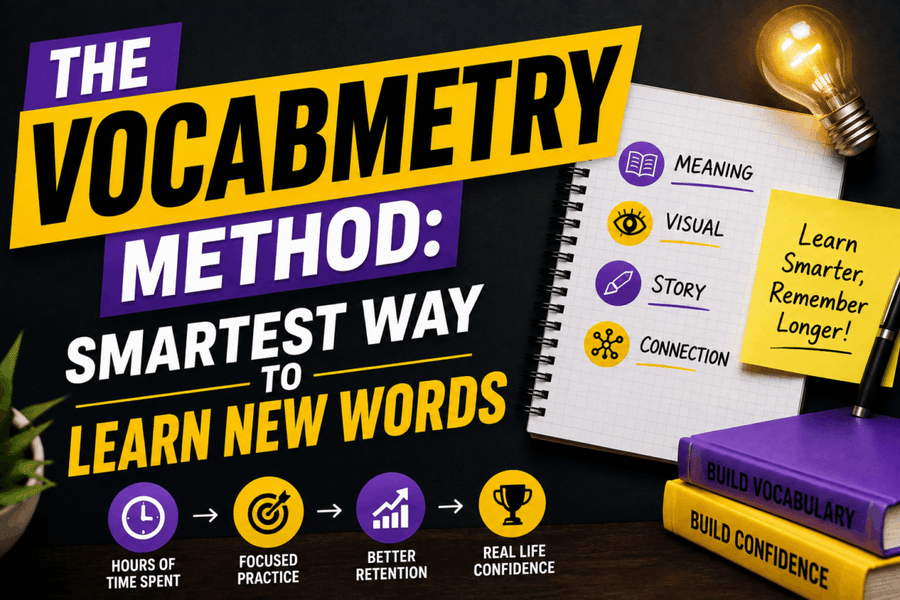
That’s when the Vocabmetry Method steps in – a patented methodology that makes it easy, enjoyable, and lasting to remember words.


More about Vocabmetry:

Story-based learning method that turns hard English words into memorable ones with the help of characters stories in – images and videos.

The story serves as a memory hook, so your mind remembers the word immediately.

You don’t merely learn the definition – you live the word.


Why is Vocabmetry the Smartest Method to Learn New Vocabulary?

▸ Instant Recall:
Instead of vague memorization, words are attached to strong associations. You recall them within seconds during exams.

▸ Exam-Focused Learning:
The approach directly benefits Synonyms, Antonyms, Jumbled Sentences, Cloze Tests, Fillers, and Error Spotting, the most common problem areas in competitive exams.

▸ Patented Formula:
It’s a patented, well-defined formula for fast vocabulary acquisition.

▸ Enjoyable & Interactive:
Studying through stories and characters engages you, unlike uninteresting word lists.

▸ Long-Term Retention:
Rather than losing words after a week, you retain them for months – even years.


The Science of Vocabmetry:

Our mind recalls pictures and tales 7x quicker than basic text. By linking each word to a character and spinning it into a narrative, Vocabmetry takes advantage of this natural ability of the human brain.

It’s the same reason you recall a film you saw years back but not a list of words you learned last week. Vocabmetry translates words into miniature “movies” in your mind.


How Vocabmetry Assists in Competitive Exams:

Whether you’re getting ready for SSC, Banking, NDA, CDS, CAT, IELTS, TOEFL, or GRE, vocabulary is not something to skip – it’s the key to success.

SSC & Banking Exams: Instantly solve vocabulary-based sections like fillers, cloze test, and error detection.

Civil Services: Improve comprehension and answer writing with a rich word bank.

Global Exams (IELTS/TOEFL/GRE): Boost your reading, writing, and speaking scores by expanding vocabulary effortlessly.


The Future of Vocabulary Learning:

In 2025 and onwards, students require intelligent learning systems that minimize time and provide real outcomes.

The Vocabmetry Method is not only about scoring high – it’s about developing a lifetime mastery of English, so that you feel more confident in exams, interviews, and the workplace.


Final Thoughts:

If words have always been your greatest obstacle, it’s time to bid farewell to the frustration of lost word lists.

With The Vocabmetry Method, you’re not simply memorizing – you’re mastering.

It’s quick, enjoyable, and scientifically proven to be effective. That’s why it’s such a clever way to master new vocabulary. 

Begin using Vocabmetry today, and see your English expertise revolutionize.


0 comment
0 FacebookTwitterPinterestEmail

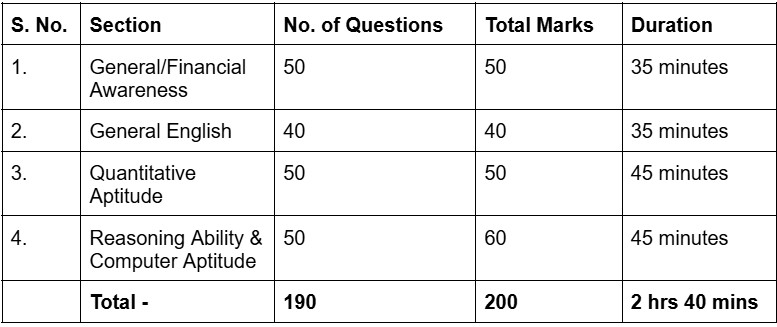
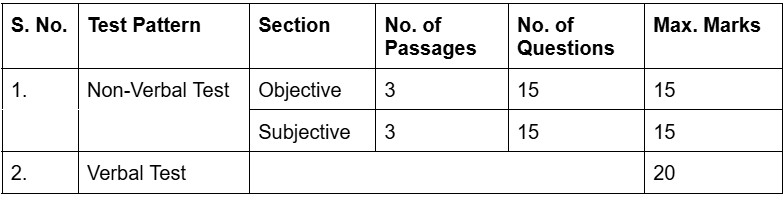
SBI Clerk 2025 Exam Pattern:

If you want to excel in the SBI Clerk 2025 examination, it’s essential to understand the complete exam structure. The recruitment process includes the Preliminary Exam, Main Exam, and the Local Language Proficiency Test (LLPT).

According to the official notification, there are no minimum qualifying marks for individual subjects and no sectional cut-offs in this year’s SBI Clerk Online Examination.

However, the final qualifying criteria will be decided by the State Bank of India.

How to prepare of SBI Clerk 2025 (Junior Associates)


SBI Clerk Preliminary Exam Pattern 2025:

SBI Clerk Mains Exam Pattern 2025:

SBI Clerk Language Proficiency Test (LLPT) Pattern:


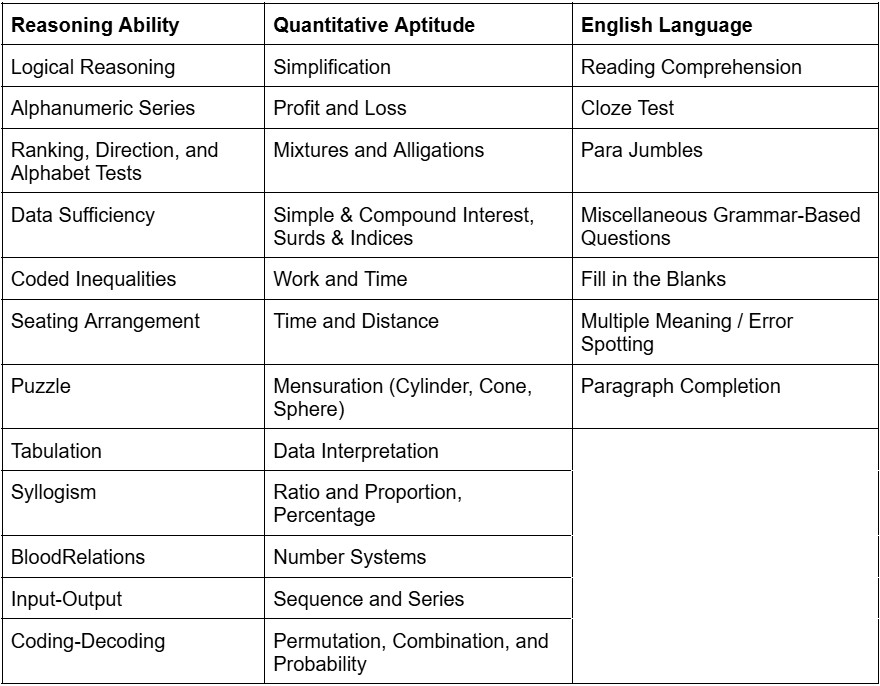
SBI Clerk 2025 – Syllabus:

How to prepare of SBI Clerk 2025 (Junior Associates)


SBI Clerk 2025 – Salary & Pay Scale:

The position of SBI Clerk (Junior Associate) offers an attractive salary package along with various allowances and benefits.

The starting monthly salary for an SBI Clerk is approximately ₹46,000, including allowances.

The pay scale is structured as follows: ₹24,050 – 1,340/3 – 28,070 – 1,650/3 – 33,020 – 2,000/4 – 41,020 – 2,340/7 – 57,400 – 4,400/1 – 61,800 – 2,680/1 – 64,480

The starting Basic Pay is ₹26,730, which includes the base of ₹24,050 along with two advance increments applicable to graduate candidates.


SBI Clerk 2025 – Preparation Strategy:

A well-planned preparation strategy is key to clearing the SBI Clerk 2025 examination.

One of the most effective ways to prepare is through live online classes and effective online courses.

How to prepare of SBI Clerk 2025 (Junior Associates)


0 comment
0 FacebookTwitterPinterestEmail
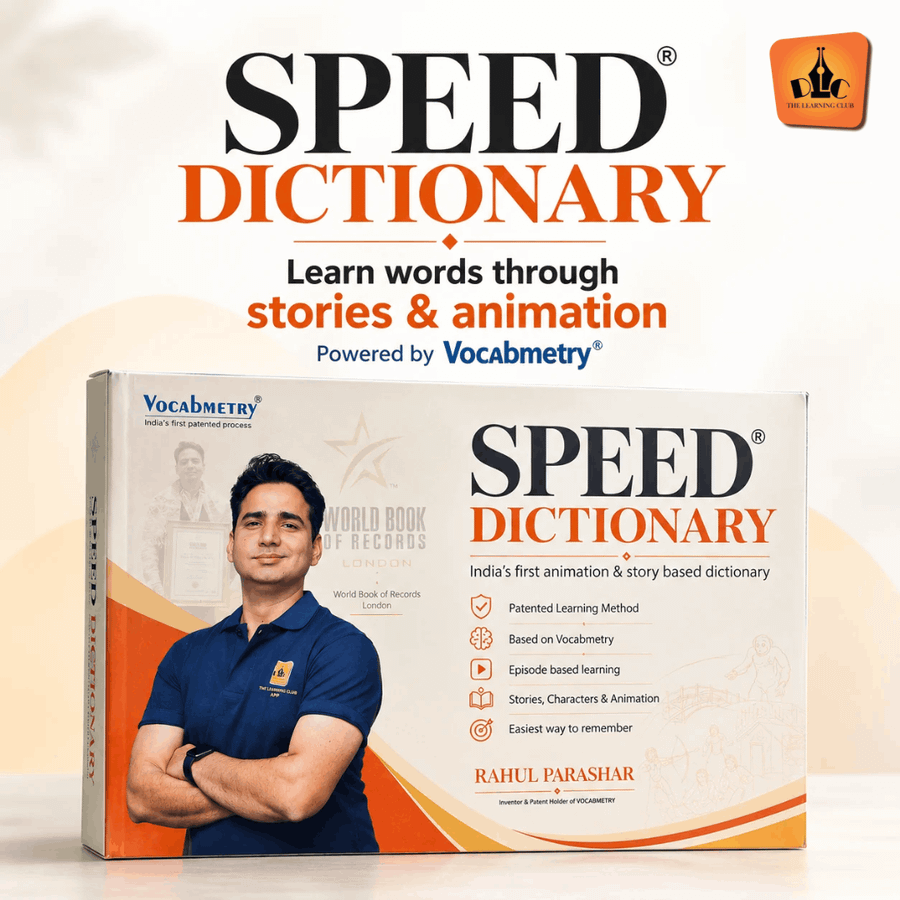
Speed Dictionary
Speed Dictionary Offer!
Improve your vocabulary using our powerful Speed Learning Method.
Original Price

₹2000

Offer Price
₹1195

Buy Now - ₹1195/-

✔ Free Home Delivery | ✔ 24/7 Support

This will close in 70 seconds