
Why India Needs Independent and Unbiased Career Counselling
By Aayush
Every year, millions of students in India complete their higher secondary education and step into colleges and universities with dreams in their eyes and hopes in their hearts. For many, this is the beginning of an exciting new journey. But there is one fundamental question that most of them have not yet answered:
What do I actually want to become?
Unfortunately, a large number of students enter this important phase of life without having a clear understanding of their interests, abilities, strengths or long-term aspirations. Yet, they begin choosing careers. Not necessarily because they have discovered their passion, but because someone else has shown them a path.
And this is where the problem begins.
The race of borrowed dreams
In India, career choices are often influenced more by society than by individual aspirations.
A student sees a friend preparing for engineering entrance examinations and decides to follow the same path. Another hears that government jobs offer security and respect, so he starts preparing for banking, SSC or other competitive examinations. Someone has an elder sibling working as an IAS officer, and suddenly civil services become the ultimate career goal.
The cycle continues.
Millions of students change their career direction simply because they become fascinated by someone else’s success. They see the destination but rarely understand the journey behind it.
We have somehow created a culture where choosing a career has become less about discovering oneself and more about following a trend.
The unfortunate reality is that many students spend some of the most valuable years of their lives preparing for careers they never genuinely wanted.
Is career counselling really helping students?
Career counselling has become a popular term in India’s education industry. Schools, colleges, coaching institutes and private organisations regularly organise career counselling sessions.
But we must ask an uncomfortable question:
Who is counselling the student, and what is their actual intention?
Imagine a student attending a career counselling session organised by an institute that specialises in air hostess training. Is the student likely to receive an unbiased assessment of all possible career opportunities, or will the discussion naturally revolve around the aviation industry?
Similarly, a coaching institute preparing students for government examinations may encourage them to pursue banking, SSC or civil services. An engineering institute may highlight engineering as the most promising career option.
This does not necessarily mean that every such organisation has bad intentions. However, their business interests can influence the advice they provide.
A student who comes seeking direction may end up receiving a sales pitch disguised as career counselling.
The biggest problem is that students, particularly those who have little exposure to different professions, often cannot distinguish between genuine guidance and promotional advice.
They trust the counsellor, accept the suggested path and begin investing their time, money and energy.
By the time they realise that the chosen profession was never meant for them, several precious years may have already passed.
Career counselling should begin with the student, not the profession
In my opinion, genuine career counselling should not be dominated by individuals or organisations promoting a particular profession or coaching programme.
It should be conducted by independent and unbiased professionals who possess a broad understanding of different career fields.
A good career counsellor should not begin by asking:
“Do you want to become an IAS officer?”
“Do you want to become an engineer?”
“Are you interested in preparing for government examinations?”
Instead, the first questions should be:
- What do you genuinely enjoy doing?
- What subjects or activities naturally attract your attention?
- What are your strengths?
- What kind of problems do you enjoy solving?
- Do you prefer working with people, technology, machines, ideas or information?
- What are your natural abilities?
- What kind of life do you imagine for yourself?
The counsellor’s responsibility should be to understand the student before suggesting a career.
They should introduce students to different professions, explain the realities, opportunities, challenges and requirements of each field, and help them evaluate their own potential.
Most importantly, they should allow students to make informed decisions rather than imposing their own preferences.
Not everyone is meant to become an IAS officer, an IITian or an IIM graduate
This is another truth that our society needs to accept.
We often measure success through a limited number of prestigious institutions and professions. Becoming an IAS officer, studying at an IIT or graduating from an IIM is undoubtedly an achievement. But these are not the only definitions of success.
Not everyone has the same abilities, interests, learning styles or aspirations.
And that is perfectly normal.
A student who is not academically inclined may possess extraordinary entrepreneurial abilities. Someone who struggles with mathematics may be an exceptional artist, designer, communicator or entrepreneur. Another student may have a natural ability to understand people, solve practical problems or work with machines.
Our education and career guidance systems must recognise these differences.
We should stop treating every student as if they are supposed to compete in the same race.
The objective should not be to make every student successful by society’s definition. It should be to help every student discover the kind of success they are capable of achieving.
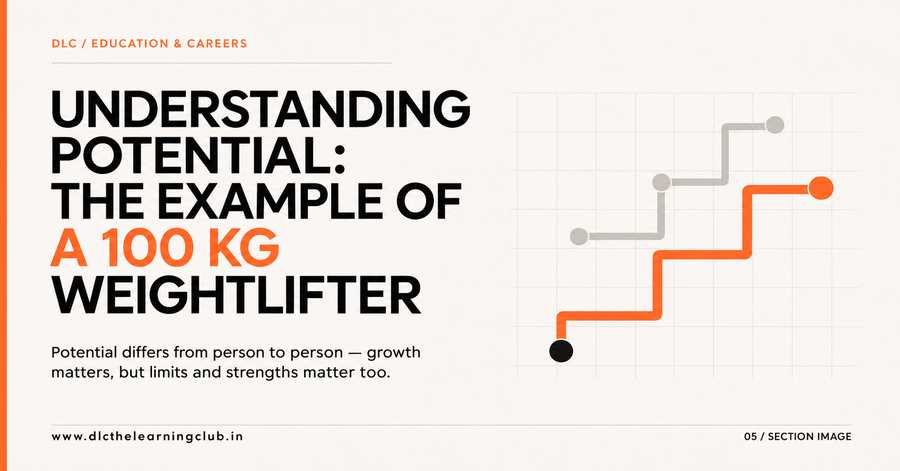
Understanding potential: The example of a 100 kg weightlifter
Let me explain this with a simple example.
Imagine a person who has the physical capacity to lift 100 kilograms. With proper training, discipline and consistent effort, perhaps that person can eventually lift 105 kilograms.
But can we realistically expect that person to lift 200 kilograms simply because someone else can?
Of course not.
The person may work harder, improve technique and increase strength, but there are individual limitations and differences in natural capacity.
Career development is not entirely different.
Every student has a different combination of intelligence, aptitude, interests, skills and potential.
We should encourage students to improve their abilities and challenge their limitations. But we should not force them into careers that are fundamentally disconnected from their strengths.
A good counsellor must understand the difference between a student’s current performance and actual potential.
The purpose of counselling is not to limit someone’s dreams. It is to help them identify a realistic path through which those dreams can be pursued.
India needs a new model of career counselling
I believe India needs a more structured and independent career counselling ecosystem.
A genuinely effective career counselling system should have the following characteristics:
1. Independent counsellors
Career counselling should be conducted by professionals who are not financially motivated to promote a particular course, coaching institute or profession.
2. Assessment before recommendation
Students should undergo proper aptitude, interest, personality and skill assessments. These assessments should support professional judgement, not replace it.
3. Exposure to multiple career options
Students must be introduced to careers beyond engineering, medicine, government services and management. India has enormous opportunities in technology, research, design, sports, agriculture, skilled trades, entrepreneurship, creative industries and emerging sectors.
4. Honest information
Students should understand the actual working conditions, income possibilities, competition, qualifications, risks and growth opportunities associated with different professions.
5. Counselling at the right age
Career awareness should begin well before students complete their higher secondary education. By the time a student reaches Class 12, they should already have some understanding of the opportunities available to them.
6. Freedom of choice
Ultimately, the decision must belong to the student. Parents and counsellors should guide, support and advise, but they should not decide a student’s entire future on their behalf.
Parents also need to change their perspective
While discussing career counselling, we cannot ignore the role of parents.
Most parents want the best for their children. Their intentions are generally good. They want financial security, social respect and a comfortable future for them.
However, sometimes parents unknowingly transfer their own unfulfilled dreams, fears and expectations to their children.
A parent who could not become a government officer may want their child to become one. Another may insist on engineering because it appears to offer a secure future.
But a child’s life should not become an extension of a parent’s unfinished ambitions.
Parents must understand that their responsibility is to provide opportunities, exposure, encouragement and guidance.
They should help children discover their strengths rather than decide their identities.
The real purpose of education
Education should not merely prepare students to qualify for examinations or secure jobs.
It should help them understand themselves, develop their abilities and identify where they can contribute meaningfully to society.
A country with millions of educated young people cannot afford to have millions of confused career seekers.
India has enormous human potential. But potential can only be converted into productivity when people are guided towards opportunities that match their abilities and interests.
We need engineers who genuinely want to build, teachers who love teaching, entrepreneurs who enjoy creating, researchers who are curious, artists who are passionate about creativity and skilled professionals who take pride in their work.
We do not need everyone to become the same thing.
We need everyone to find their own direction.
The question we must start asking
Perhaps the biggest mistake we make as a society is asking children:
“What do you want to become when you grow up?”
Instead, we should first help them discover:
“Who are you, what are you good at, what interests you, and where can your abilities take you?”
Because a career is not merely a profession that provides an income. It occupies a significant part of our lives, shapes our identity and influences our happiness.
A student should not spend ten years chasing a dream simply because it once belonged to someone else.
India does not need another generation of young people blindly following popular career trends.
It needs a generation that understands its own potential, makes informed decisions and has the courage to choose a different path.
Let us stop telling students what they should become.
Let us start helping them discover what they can become.
Because the right career is not necessarily the most popular career. It is the career in which a person can discover their abilities, develop their potential and build a meaningful life.