
competitive exams

Important government exams in December 2026, featuring UPSC, SSC, RRB and banking exams, exam calendar and career opportunities.

Upcoming Exam Calendar and  Career Opportunities.

By Ayush | Education & Skill Development

December 2026 is going to be an important month for millions of government job aspirants across India. Several major recruitment and eligibility examinations are scheduled, offering opportunities in banking, teaching, research, administration and other professional fields.

For students preparing for government jobs, the coming weeks are crucial. While some candidates are revising their syllabi, others are preparing for preliminary examinations, mains examinations and the next stages of recruitment.

Here is a list of important examinations scheduled for December 2026.

1. Important Government Examinations in December 2026
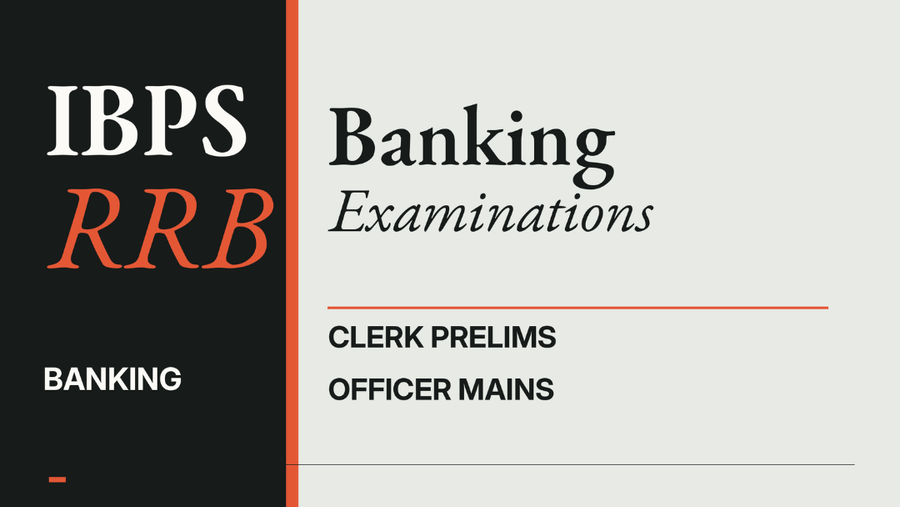
IBPS RRB examination graphic for government exams in December 2026
Examination Conducting authority Scheduled date
IBPS RRB Office Assistant (Clerk) Prelims IBPS 6, 12 & 13 December
CTET December Session CBSE 12–13 December
UPSC SO / Stenographer LDCE UPSC From 12 December; two-day examination
UGC NET December Session NTA 14–18 & 21 December
IBPS RRB Officer Scale I Mains IBPS 20 December
IBPS RRB Officer Scale II & III IBPS 20 December
IBPS Customer Service Associate Mains IBPS 27 December
SSC CHSL Tier-I SSC 30 November–31 December (proposed window)

Important: The IBPS calendar is tentative and candidates should verify their individual examination dates through their call letters. SSC CHSL’s December examination window is proposed, with the exact schedule to be confirmed by SSC. The UPSC SO/Stenographer LDCE is a restricted departmental examination, not an open recruitment examination for all graduates.

Official examination websites:

2. 6. What Happens After You Clear the Government Examination?

This is where many aspirants make a mistake.

They prepare for years to clear an examination but do not think sufficiently about the skills required after selection.

Let’s understand what happens next in some important career pathways.

A. After Clearing IBPS Banking Examinations
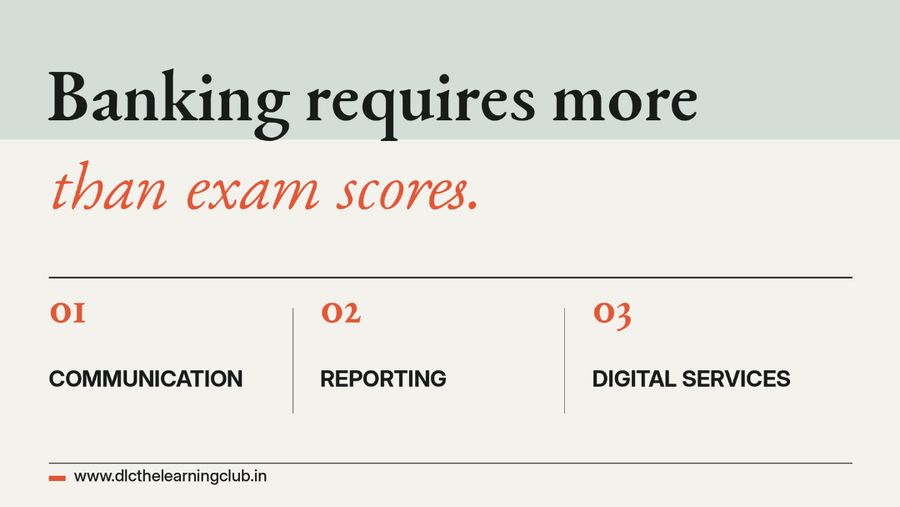
Banking careers require professional communication and skills beyond examination scores

Candidates who qualify through the prescribed selection process may receive provisional allotment to participating banks, followed by document verification and other joining formalities.

A banking professional needs to interact with customers, understand financial products, explain procedures, prepare correspondence and handle digital banking services.

English can be particularly useful when dealing with official circulars, banking terminology, reports and professional communication.

B. After Qualifying CTET

CTET qualification makes candidates eligible to be considered for teaching appointments in accordance with applicable recruitment rules.

It does not automatically guarantee a government teaching job.

Teachers need to develop subject knowledge, classroom communication, lesson planning and the ability to explain concepts effectively.

English proficiency can also help teachers access educational resources and modern teaching material.

C. After Qualifying UGC NET

Depending on the result category and applicable rules, candidates may become eligible for:

  • Assistant Professor recruitment.
  • Junior Research Fellowship (JRF).
  • PhD admission under applicable eligibility provisions.

For an academic or research career, reading research papers, understanding academic terminology, preparing research proposals and writing publications can require substantial English proficiency.

D. After Clearing Other Government Recruitment Examinations
UPSC and SSC government examination and public administration career pathways

Whether someone joins a ministry, public-sector organisation, bank, administrative office or government institution, professional responsibilities often include:

  • Reading official communications.
  • Preparing reports and presentations.
  • Drafting emails and letters.
  • Understanding technical documents.
  • Participating in meetings.
  • Communicating with different stakeholders.

The examination may secure the opportunity, but professional skills help individuals grow within their careers.

3. What Does Research Tell Us Skills in India?

Study 1: Mercer | Mettl – India’s Graduate Skill Index 2025

According to the Mercer | Mettl India Graduate Skill Index 2025, based on its 2024 assessment data:

  • Communication skills employability stood at 55.1%.
  • Critical-thinking skills employability stood at 54.6%.
  • Leadership skills employability stood at 54.2%.

The report also assessed more than one million students across over 2,700 campuses.

These findings highlight the importance of communication and other soft skills in professional readiness.

However, these figures measure assessed graduate employability skills, not English examination pass rates or the performance of Hindi-medium students specifically.

Study 2: ASER Rural Report 2024

The Annual Status of Education Report (ASER) 2024 assessed foundational learning among children aged 5–16 across rural India.

One of its findings showed that 48.7% of rural students enrolled in Standard V could read a Standard II-level text in their assessment language.

This is an important reminder that foundational reading ability itself needs attention.

ASER’s reading figures are not an English proficiency survey. They should not be interpreted as evidence that a particular percentage of students cannot read English.

What should we learn from these studies?

The findings point towards a larger educational challenge: students need stronger foundations in reading, comprehension, critical thinking and communication.

English language development should therefore become a part of long-term academic and career preparation, not something students begin studying only a few weeks before an examination.
Author – Ayush
1 comment
0 FacebookTwitterPinterestEmail
Image illustrating strategies to enhance English vocabulary for competitive exams, featuring tips and resources

How to Improve English Vocabulary for Competitive Exams: 30 Powerful Ways That Actually Work

If you are searching for how to improve English vocabulary for competitive exams, you are not alone. Thousands of students preparing for SSC, Bank, CLAT, CAT, defence, and other exams struggle with the same issue: they study words today and forget them tomorrow. The good news is that vocabulary is not a talent. It is a skill, and skills can be built with the right system. That is exactly where a structured learning approach makes a big difference. DLC The Learning Club positions itself around English vocabulary, grammar, and exam-ready learning through its VOCABMETRY approach and digital learning platform, which makes this topic a natural fit for its audience.

Why English Vocabulary Matters in Competitive Exams

Vocabulary is not just one chapter inside the English section. It affects how you understand reading comprehension, sentence improvement, cloze tests, para jumbles, idioms, and even instructions. Exam-prep publishers regularly highlight vocabulary, comprehension, error spotting, and related English topics as core scoring areas across competitive exams. That means a better word bank can improve both speed and confidence.

Where vocabulary questions appear most often

In most competitive exams, vocabulary appears directly in:

  • synonyms and antonyms
  • one-word substitutions
  • idioms and phrases
  • cloze tests
  • fill in the blanks
  • reading comprehension

It also appears indirectly. A student may know grammar well, but if the words inside the options feel unfamiliar, accuracy drops. That is why vocabulary is not a side topic. It is a score multiplier.

Why vocabulary improves accuracy beyond the English section

A stronger vocabulary helps students read faster, guess less, and understand tone more clearly. In long passages, one unknown keyword can distort the meaning of an entire paragraph. In verbal reasoning and legal aptitude contexts too, language precision matters. For an institute like DLC The Learning Club, which already serves learners interested in language and competitive-exam readiness, vocabulary-focused content can attract students at the exact point where they are looking for help. That is an inference based on DLC’s course focus and the kinds of vocabulary articles regularly published by exam brands.

The Real Reason Students Forget New Words

Let’s be honest. Most students do not fail because they are lazy. They fail because they use weak methods.

They read a list.
They underline a few words.
They say, “I’ll revise later.”
And then—poof—the words are gone.

Passive learning vs active recall

Reading a word is passive. Remembering it without seeing the answer is active recall. The brain stores information better when it has to retrieve it. So, instead of reading “abate = reduce,” close the notebook and ask yourself, “What does abate mean?” That small change makes revision far more effective. Vocabulary resources for competitive exams often pair words with meanings, examples, and practice formats because recall improves when students use words in context, not when they only look at lists.

Why cramming fails before exams

Cramming creates the illusion of progress. A student may “recognize” 50 words tonight and forget 40 by next week. Long-term retention needs spaced revision. In plain words, you must come back to the same word after 1 day, 3 days, 7 days, and 15 days. That is how memory gets stronger. App-based and episode-based learning systems can support this kind of repetition more easily than random notebooks, which is one reason digital learning platforms often appeal to exam aspirants.

How to Improve English Vocabulary for Competitive Exams with a 30-Day Plan

Here comes the practical part. This plan is simple, realistic, and designed for busy students.

Week 1: Build the habit

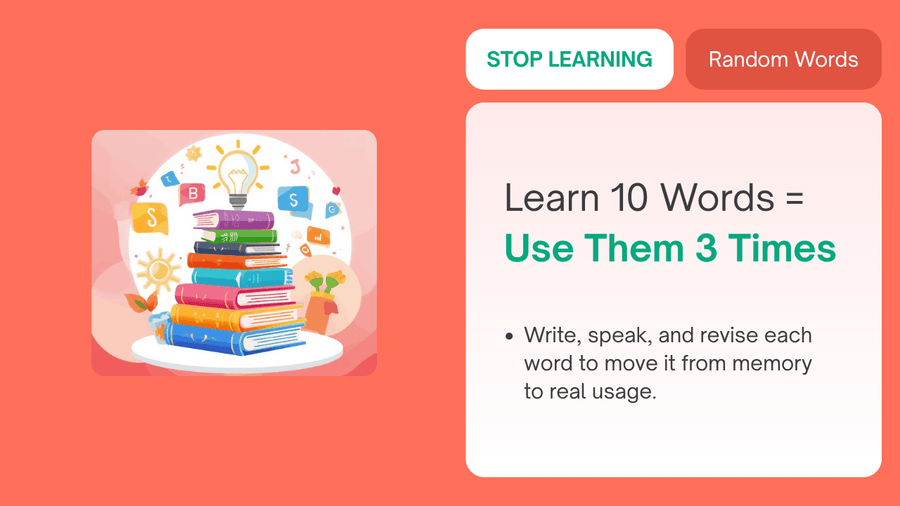
Goal: Learn 10 words a day and revise them every night.

What to do:

  • Learn 5 words in the morning and 5 in the evening
  • Write meaning, synonym, antonym, and one sentence
  • Revise all 10 words before sleeping
  • Read one short editorial or article and underline new words

Do not aim for perfection in week 1. Aim for consistency. Even 70 words learned properly are better than 300 words skimmed badly.

Week 2: Learn by usage

Goal: Move from memory to application.

What to do:

  • Use 10 old words in self-made sentences
  • Solve 10 fill-in-the-blank questions daily
  • Group similar words together
  • Start learning roots, prefixes, and suffixes

This stage matters because vocabulary grows faster when words connect to other words. For example, once you know “bene” means good, words like benefit and benevolent become easier to remember.

English Vocabulary Tips For You!

English Vocabulary Tips For You!

Week 3: Practice in exam format

Goal: Train your brain to recognize words under pressure.

What to do:

  • Solve cloze tests
  • Practice reading comprehension
  • Attempt synonym-antonym quizzes
  • Set a timer for 15–20 minutes

Many students know words at home but freeze in mock tests. Why? Because they never trained with time pressure. Vocabulary must shift from “I know this word” to “I can use it quickly.”

Week 4: Revise for retention

Goal: Make your learning stick.

What to do:

  • Revise all words from weeks 1 to 3
  • Mark difficult words in red
  • Test yourself without notes
  • Create mini quizzes every day
  • Use tough words in conversation or writing

By the end of 30 days, the student who follows this system seriously will not just know more words. They will think more clearly in English.

10 Smart Techniques to Learn Words Faster

1. Learn root words

Root-based learning helps you decode unfamiliar words. One root can unlock many words.

2. Study prefixes and suffixes

Un-, dis-, pre-, anti-, -able, -tion, and -ment appear often. Learn them once and many words become easier.

3. Use synonyms and antonyms

A word becomes stronger in memory when it lives inside a word family.

4. Make your own sentence

A self-made sentence is easier to remember than a dictionary sentence.

5. Use visual memory

Turn the word into a picture in your mind. It sounds silly, but it works.

6. Revise in short bursts

Ten focused minutes beat one sleepy hour.

7. Read aloud

Hearing the word improves retention and pronunciation.

8. Maintain a personal vocabulary journal

This becomes your revision goldmine.

9. Learn high-frequency words first

Do not chase fancy words before mastering common exam words.

10. Practice mixed question sets

Real exams mix vocabulary with grammar and comprehension, so your practice should too. These methods line up with broader competitive-exam advice that emphasizes reading, journaling, usage, flashcards, and repeated practice rather than one-time memorization.

Daily Habits That Make Vocabulary Stick

Read editorials and short articles

You do not need to read a whole newspaper from top to bottom. One quality article a day is enough. Focus on understanding context, tone, and repeated words. When a word appears naturally inside an article, your brain remembers it better than when it appears in a dry list.

Keep a vocabulary journal

Split each page into:

  • word
  • meaning
  • synonym
  • antonym
  • sentence
  • revision date

That last column is the secret sauce. Without revision dates, a notebook becomes a graveyard of forgotten effort.

Speak and write with new words

Use new words in WhatsApp drafts, diary entries, essays, or spoken English practice. Active usage turns a word from “familiar” into “owned.” Platforms that teach vocabulary through repeated content and guided lessons can help students create this habit more consistently, especially when learning through video or app-based modules.

Common Vocabulary Mistakes Competitive Exam Aspirants Make

Memorizing without context

A word without a sentence is weak. Context gives meaning life.

Ignoring revision

Students spend hours learning and minutes revising. That ratio should be reversed.

Studying rare words before useful ones

Common exam words give better returns than obscure words.

Depending only on PDFs

PDFs are useful, but they do not automatically create retention. You still need recall, revision, and testing.

Avoiding reading comprehension

Some students say, “I only want vocabulary, not RC.” That is like wanting muscles without exercise. RC forces vocabulary into action. Resources for exam aspirants repeatedly combine vocabulary with comprehension and usage for that reason.

Best Types of Vocabulary Questions to Practice

Cloze tests

These help you choose the right word based on sentence flow and tone.

Reading comprehension

This improves contextual guessing and reading speed.

Fill in the blanks

Excellent for learning collocations and sentence logic.

Synonyms and antonyms

Useful for direct vocabulary building.

Idioms and phrases

Very common in many competitive exams and easy to score with revision.

One-word substitutions

A favorite in many English sections because it tests both understanding and precision.

How DLC The Learning Club Can Help Students Learn Faster

DLC The Learning Club describes itself as an education platform focused on English vocabulary, grammar, and complicated topics, and highlights its VOCABMETRY process across its main website, app presence, and course pages. Its course messaging also points to vocabulary for competitive exams, while its Graphy page emphasizes episode-based learning. For students, that matters because structured repetition, guided lessons, and app-based access can make consistency much easier than unplanned self-study.

What makes this relevant for SEO is simple: the brand’s actual strengths match a real student pain point. That is the sweet spot for traffic content. A blog post on how to improve English vocabulary for competitive exams can bring in:

  • students searching for English improvement tips
  • aspirants preparing for exams
  • users looking for vocabulary courses or apps
  • parents comparing learning platforms

In other words, the topic can attract informational traffic at the top of the funnel and still lead naturally to DLC’s learning ecosystem. That is an inference from DLC’s positioning and the visible search landscape around vocabulary and exam prep.

A Sample 7-Day Vocabulary Routine

Day Task Time
Monday Learn 10 new words + revise 10 old words 30 min
Tuesday Read one article + note 5 new words 25 min
Wednesday Practice synonyms, antonyms, and fill in the blanks 30 min
Thursday Solve one cloze test + revise difficult words 30 min
Friday Use 15 words in sentences 25 min
Saturday Take a vocabulary mini-test 20 min
Sunday Full revision of the week 40 min

This simple routine beats random studying every single time.

25 High-Utility Words Students Should Know

Word Meaning Quick Use
Abate Become less The pain began to abate
Adept Skilled She is adept at analysis
Alleviate Reduce pain or trouble This may alleviate stress
Ambiguous Unclear The statement was ambiguous
Benevolent Kind A benevolent leader
Candid Honest Give a candid answer
Coherent Logical Write a coherent paragraph
Concise Brief and clear Keep your answer concise
Credible Believable Use credible sources
Diligent Hardworking A diligent student improves
Eloquent Fluent and persuasive An eloquent speaker
Frugal Careful with money A frugal lifestyle
Imminent About to happen Results are imminent
Lucid Easy to understand A lucid explanation
Meticulous Very careful Be meticulous in revision
Novice Beginner Every topper was once a novice
Omit Leave out Do not omit examples
Pragmatic Practical Take a pragmatic approach
Resilient Able to recover Be resilient after mock tests
Scrutinize Examine carefully Scrutinize every option
Sporadic Irregular Sporadic study gives weak results
Tenacious Persistent Be tenacious in preparation
Validate Confirm Validate your answer
Versatile Able to adapt A versatile vocabulary helps
Wary Careful or cautious Be wary of guesswork

FAQs

1. How many words should I learn daily for competitive exams?

A realistic target is 10 words a day with revision. That gives you 300 words in a month, which is far better than learning 50 words once and forgetting most of them.

2. What is the best way to remember difficult English words?

Use active recall, spaced revision, and self-made sentences. Words stay longer when you use them, not when they only read them.

3. Is reading newspapers enough to improve vocabulary?

Reading helps a lot, but reading alone is not enough. You also need revision, testing, and usage. Newspapers build exposure; practice builds retention.

4. Which is more important for exams: grammar or vocabulary?

Both matter, but vocabulary improves multiple areas at once, including comprehension, cloze tests, and direct word-based questions. Strong vocabulary often supports grammar-based performance too.

5. Can Hindi-medium students build strong English vocabulary?

Absolutely. Many students from Hindi-medium backgrounds improve quickly when they use a consistent system with meanings, examples, and regular revision. Recent exam-prep guidance explicitly says strong English scores are achievable for Hindi-medium aspirants with steady practice.

6. How long does it take to see improvement in English vocabulary?

Most students notice better recall and reading comfort within 3 to 4 weeks of structured practice. Strong long-term improvement usually takes a few months of consistency.

7. Can an app help in vocabulary preparation?

Yes, especially when it offers guided lessons, repeated exposure, and easy daily access. That is one reason learning apps and digital course platforms remain popular for exam preparation. DLC The Learning Club’s app and course ecosystem are built around this kind of structured access.

Conclusion

The answer to how to improve English vocabulary for competitive exams is not “study harder.” It is “study smarter.” Learn fewer words, but learn them properly. Revise on schedule. Read with attention. Practice with context. Test yourself often. And use a structured system that keeps you consistent.

0 comment
0 FacebookTwitterPinterestEmail
Speed Dictionary
Speed Dictionary Offer!
Improve your vocabulary using our powerful Speed Learning Method.
Original Price

₹2000

Offer Price
₹1195

Buy Now - ₹1195/-

✔ Free Home Delivery | ✔ 24/7 Support

This will close in 70 seconds