
Home » 100 Most Important English Words for SSC, Banking & Exams (With Meaning + Usage)

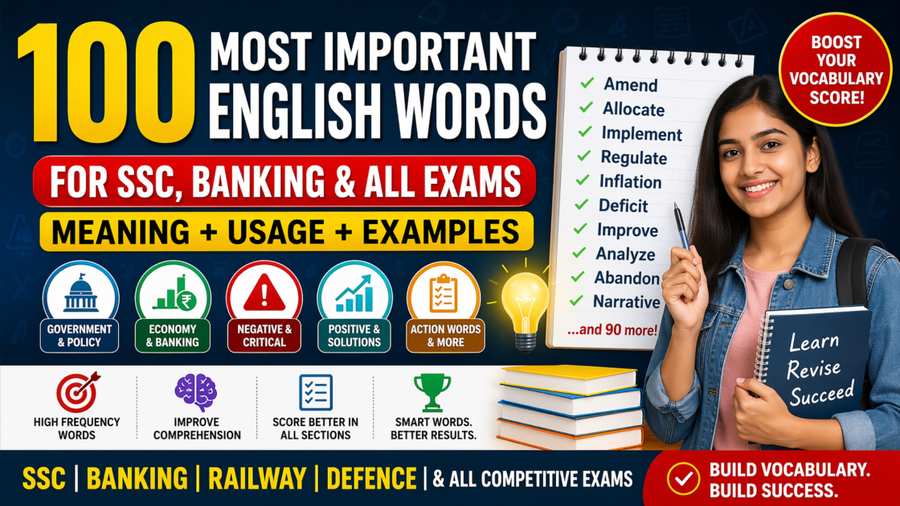
100 Most Important English Words for SSC, Banking & Exams (With Meaning + Usage)

If you are preparing for SSC, Banking, रेलवे, Defence, State Exams, CDS, NDA, UPSC prelim-level English, or any other competitive exam, then one thing is clear: English vocabulary can change your score fast.

by dlcthelearningclub.in
SSC • Banking • Competitive Exams

500 Most Important English Words for SSC, Banking & Exams (With Meaning + Usage)

Build a stronger vocabulary for comprehension, cloze test, synonyms, antonyms, one word substitution, error detection, fill in the blanks, phrase replacement, and sentence improvement with this exam-focused word list.

Many students spend months studying grammar, mock tests, and comprehension, but still lose marks in questions based on:

  • One word substitution
  • Synonyms and antonyms
  • Cloze test
  • Reading comprehension
  • Error detection
  • Phrase replacement
  • Fill in the blanks
  • Sentence improvement

The reason is simple: their vocabulary is weak.

That is why learning the 100 most important English words for SSC, Banking & other competitive exams can be one of the smartest things you do for your preparation.

100 Important English Words for SSC, Banking & Other Competitive Exams

Category 1: Government / Policy / News

Very high frequency words that appear in editorials, policy passages, and comprehension sets.

1. Amend

Meaning: to change officially

Usage: The constitution was amended.

2. Allocate

Meaning: to assign resources

Usage: Funds were allocated for education.

3. Implement

Meaning: to put into action

Usage: The policy was implemented nationwide.

4. Regulate

Meaning: to control by rules

Usage: The government regulates banking systems.

5. Enforce

Meaning: to make laws effective

Usage: Police enforce traffic rules.

6. Repeal

Meaning: to cancel a law

Usage: The act was repealed.

7. Draft

Meaning: prepare document

Usage: A draft bill was presented.

8. Sanction

Meaning: approval OR penalty (important dual meaning)

Usage: The project got government sanction.

9. Subsidy

Meaning: financial support

Usage: Farmers received subsidies.

10. Initiative

Meaning: new plan

Usage: Government launched an initiative.

Category 2: Economy / Banking

Very important for IBPS, SBI, RBI, and economy-based reading passages.

11. Inflation

Meaning: rise in prices

Usage: Inflation affects purchasing power.

12. Deficit

Meaning: shortage

Usage: Fiscal deficit increased.

13. Revenue

Meaning: income

Usage: Tax revenue increased.

14. Expenditure

Meaning: spending

Usage: Government expenditure rose.

15. Liquidity

Meaning: cash availability

Usage: Banks need liquidity.

16. Credit

Meaning: loan facility

Usage: Credit growth is rising.

17. Debt

Meaning: borrowed money

Usage: The country has high debt.

18. Collapse

Meaning: sudden failure

Usage: The market collapsed.

19. Surge

Meaning: sudden increase

Usage: Demand saw a surge.

20. Decline

Meaning: decrease

Usage: Sales declined this quarter.

Category 3: Negative / Critical Tone

Very common in reading comprehension, editorial passages, and opinion-based English questions.

21. Criticize

Meaning: to find fault

Usage: The policy was criticized.

22. Condemn

Meaning: strongly criticize

Usage: Leaders condemned the act.

23. Allegation

Meaning: accusation without proof

Usage: Allegations were made.

24. Corruption

Meaning: dishonest practice

Usage: Corruption harms development.

25. Crisis

Meaning: serious problem

Usage: The country faced a crisis.

26. Threat

Meaning: danger

Usage: Pollution is a threat.

27. Conflict

Meaning: disagreement

Usage: Conflict delayed progress.

28. Dispute

Meaning: argument

Usage: Legal dispute arose.

29. Controversy

Meaning: public disagreement

Usage: The decision caused controversy.

30. Violation

Meaning: breaking rules

Usage: Human rights violation occurred.

Category 4: Positive / Solution Words

Useful in comprehension, sentence improvement, and tone-based vocabulary questions.

31. Improve

Meaning: make better

Usage: Conditions improved.

32. Enhance

Meaning: increase quality

Usage: Skills were enhanced.

33. Boost

Meaning: increase

Usage: Policy boosted economy.

34. Promote

Meaning: encourage

Usage: Government promotes education.

35. Develop

Meaning: grow

Usage: Infrastructure developed.

36. Achieve

Meaning: succeed

Usage: Goals were achieved.

37. Progress

Meaning: forward movement

Usage: The country made progress.

38. Efficient

Meaning: working well

Usage: System is efficient.

39. Sustainable

Meaning: long-lasting

Usage: Sustainable growth is needed.

40. Stable

Meaning: steady

Usage: Economy is stable.

Category 5: Common Exam Action Words

Words that often appear in instructions, reasoning, data interpretation, and English sections.

41. Analyze

Meaning: examine

Usage: Analyze the data.

42. Assess

Meaning: evaluate

Usage: Teachers assess students.

43. Interpret

Meaning: explain meaning

Usage: Interpret the passage.

44. Conclude

Meaning: finish/decide

Usage: We conclude that…

45. Indicate

Meaning: show

Usage: Data indicates growth.

46. Suggest

Meaning: propose

Usage: Report suggests changes.

47. Reveal

Meaning: show hidden truth

Usage: Study revealed facts.

48. Demonstrate

Meaning: prove

Usage: Results demonstrate success.

49. Identify

Meaning: recognize

Usage: Identify errors.

50. Compare

Meaning: find similarities

Usage: Compare both options.

Category 6: High-Frequency Advanced Words

SSC favorite words for vocabulary, one word substitution, and editorial-based questions.

51. Abandon

Meaning: to leave completely

Usage: He abandoned the plan.

52. Abolish

Meaning: to officially end

Usage: The old rule was abolished.

53. Abrupt

Meaning: sudden and unexpected

Usage: There was an abrupt change in policy.

54. Adverse

Meaning: unfavorable or harmful

Usage: The company faced adverse conditions.

55. Advocate

Meaning: to support publicly

Usage: Many experts advocate reform.

56. Alleviate

Meaning: to reduce pain or difficulty

Usage: The scheme may alleviate poverty.

57. Ambiguous

Meaning: unclear or having more than one meaning

Usage: The statement was ambiguous.

58. Arbitrary

Meaning: based on personal choice, not reason

Usage: The decision seemed arbitrary.

59. Benevolent

Meaning: kind and generous

Usage: He was known as a benevolent leader.

60. Coherent

Meaning: logical and clear

Usage: Her answer was clear and coherent.

61. Comprehensive

Meaning: complete and detailed

Usage: The report gives a comprehensive view.

62. Deteriorate

Meaning: to become worse

Usage: The situation continued to deteriorate.

63. Eliminate

Meaning: to remove completely

Usage: The new system will eliminate errors.

64. Emerge

Meaning: to come out or appear

Usage: New problems began to emerge.

65. Evident

Meaning: clearly seen or understood

Usage: His disappointment was evident.

66. Feasible

Meaning: possible and practical

Usage: The plan is feasible.

67. Inevitable

Meaning: certain to happen

Usage: Change is inevitable.

68. Justify

Meaning: to show to be right

Usage: The facts justify the decision.

69. Legitimate

Meaning: lawful or valid

Usage: It was a legitimate concern.

70. Mitigate

Meaning: to make less severe

Usage: Steps were taken to mitigate damage.

Category 7: Common Editorial Words

Frequently seen in newspaper passages, editorials, and exam comprehension sets.

71. Narrative

Meaning: a spoken or written account

Usage: The article presents a clear narrative.

72. Perspective

Meaning: a particular point of view

Usage: We need a broader perspective.

73. Trend

Meaning: a general direction of change

Usage: This trend is worrying.

74. Impact

Meaning: strong effect or influence

Usage: The policy had a positive impact.

75. Consequence

Meaning: result or effect

Usage: Every action has a consequence.

76. Factor

Meaning: an element that influences something

Usage: Cost is an important factor.

77. Issue

Meaning: an important subject or problem

Usage: Climate change is a major issue.

78. Approach

Meaning: a method of doing something

Usage: The government adopted a new approach.

79. Strategy

Meaning: a planned method to achieve something

Usage: The team changed its strategy.

80. Framework

Meaning: a basic structure or system

Usage: The law provides a clear framework.

Category 8: Daily Use + Exam Mix

Common words that are simple but very useful in tests and reading passages.

81. Attempt

Meaning: to try

Usage: She attempted all the questions.

82. Avoid

Meaning: to stay away from

Usage: Avoid careless mistakes.

83. Continue

Meaning: to keep going

Usage: The classes will continue next week.

84. Create

Meaning: to make

Usage: The new rule may create problems.

85. Decide

Meaning: to make a choice

Usage: The board will decide tomorrow.

86. Explain

Meaning: to make clear

Usage: Please explain your answer.

87. Improve

Meaning: to make better

Usage: Practice will improve your score.

88. Maintain

Meaning: to keep in the same condition

Usage: It is hard to maintain quality.

89. Reduce

Meaning: to make less

Usage: The medicine helps reduce pain.

90. Support

Meaning: to help or back up

Usage: Parents should support students.

Category 9: Important Connecting Words

Very important in cloze test, sentence arrangement, and comprehension flow.

91. However

Meaning: in contrast / but

Usage: The plan was good; however, it failed.

92. Therefore

Meaning: for that reason

Usage: He worked hard; therefore, he succeeded.

93. Moreover

Meaning: in addition

Usage: The course is affordable; moreover, it is effective.

94. Although

Meaning: even though

Usage: Although he was tired, he continued.

95. Despite

Meaning: in spite of

Usage: Despite the rain, the match continued.

96. Whereas

Meaning: while on the other hand

Usage: She likes tea, whereas I prefer coffee.

97. Hence

Meaning: for this reason

Usage: The roads were blocked; hence, we were late.

98. Thus

Meaning: so / as a result

Usage: He practiced daily, thus improving his speed.

99. Meanwhile

Meaning: at the same time

Usage: She prepared the notes; meanwhile, I revised the chapter.

100. Consequently

Meaning: as a result

Usage: He ignored the warning; consequently, he failed.

Best Sources for Important Exam Vocabulary

If you want to build strong exam vocabulary, focus on:

  • previous year SSC papers
  • previous year Banking papers
  • newspaper editorials
  • quality vocabulary lists
  • exam-focused reading passages
  • regular mock test practice
Do not depend only on random social media word lists. Many of them are not useful for real exams.

Common Mistakes Students Make While Learning Vocabulary

Memorizing without context — A word without a sentence is hard to retain.

Learning too many words at once — This causes overload and poor revision.

Not revising — Most forgetting happens because students move ahead without revision.

Ignoring usage — Many students know the Hindi meaning but cannot identify the correct usage.

Avoiding reading practice — Vocabulary improves fastest when you read good English daily.

Why 100 Important Words Can Be a Game Changer

You do not need perfect English to score well in competitive exams.

You need smart preparation.

A carefully selected list of 100 important English words can help you:

  • answer vocabulary questions better
  • improve comprehension speed
  • understand editorials more easily
  • perform better in mock tests
  • gain confidence in the English section

For many aspirants, this becomes the difference between an average score and a selection-worthy score.

Final Advice for SSC and Banking Aspirants

If you are serious about cracking exams, then start treating vocabulary as a daily scoring subject, not a side topic.

Even 15 minutes a day can create huge improvement over time.

Do not wait for the “perfect day” to start.

Start today.

  • Learn 10 words.
  • Revise yesterday’s 10.
  • Use them in sentences.
  • Read one passage.
  • Repeat daily.

That is how exam English becomes easy.

Conclusion

The 500 most important English words for SSC, Banking & Exams are not just a word list—they are a scoring tool.

When learned with meaning + usage + revision, these words can strengthen your overall English preparation in a powerful way.

If you stay consistent, vocabulary will stop feeling like a weak area and start becoming one of your strengths.

So begin now, build your word bank step by step, and make English work in your favor in every exam.

FAQs

How many English words should I learn daily for SSC exams?

A good target is 10 to 15 words daily with revision.

Are 100 words enough for Banking and SSC exams?

They give you a very strong base, especially when combined with reading practice and mock tests.

Is vocabulary important for cloze test and comprehension?

Yes. Vocabulary is extremely important for both.

What is the best way to remember English words for exams?

Learn words with meaning, sentence usage, revision, and memory tricks.

Can I improve vocabulary without reading newspapers?

Yes, but newspapers and editorials make improvement much faster.

You may also like

Leave a Comment

Level 1 Vocab

Do you want Level 1 Vocab offer?
Get Instant access

Original Price: ₹2299 

Now Only ₹299/-

Mobile Access

(1 Year Validity)

Register Now for ₹299

Secure Payment • Instant Access

This will close in 60 seconds

Speed Dictionary


Speed Dictionary Offer!

Improve your vocabulary using our powerful Speed Learning Method.

Original Price
₹2000
Offer Price
₹999

Buy Now - Rs.999/-


✔ Free Home Delivery    ✔ 24/7 Support

This will close in 70 seconds