
How to Improve English Vocabulary for Competitive Exams: 30 Powerful Ways That Actually Work
If you are searching for how to improve English vocabulary for competitive exams, you are not alone. Thousands of students preparing for SSC, Bank, CLAT, CAT, defence, and other exams struggle with the same issue: they study words today and forget them tomorrow. The good news is that vocabulary is not a talent. It is a skill, and skills can be built with the right system. That is exactly where a structured learning approach makes a big difference. DLC The Learning Club positions itself around English vocabulary, grammar, and exam-ready learning through its VOCABMETRY approach and digital learning platform, which makes this topic a natural fit for its audience.
Why English Vocabulary Matters in Competitive Exams
Vocabulary is not just one chapter inside the English section. It affects how you understand reading comprehension, sentence improvement, cloze tests, para jumbles, idioms, and even instructions. Exam-prep publishers regularly highlight vocabulary, comprehension, error spotting, and related English topics as core scoring areas across competitive exams. That means a better word bank can improve both speed and confidence.
Where vocabulary questions appear most often
In most competitive exams, vocabulary appears directly in:
- synonyms and antonyms
- one-word substitutions
- idioms and phrases
- cloze tests
- fill in the blanks
- reading comprehension
It also appears indirectly. A student may know grammar well, but if the words inside the options feel unfamiliar, accuracy drops. That is why vocabulary is not a side topic. It is a score multiplier.
Why vocabulary improves accuracy beyond the English section
A stronger vocabulary helps students read faster, guess less, and understand tone more clearly. In long passages, one unknown keyword can distort the meaning of an entire paragraph. In verbal reasoning and legal aptitude contexts too, language precision matters. For an institute like DLC The Learning Club, which already serves learners interested in language and competitive-exam readiness, vocabulary-focused content can attract students at the exact point where they are looking for help. That is an inference based on DLC’s course focus and the kinds of vocabulary articles regularly published by exam brands.
The Real Reason Students Forget New Words
Let’s be honest. Most students do not fail because they are lazy. They fail because they use weak methods.
They read a list.
They underline a few words.
They say, “I’ll revise later.”
And then—poof—the words are gone.
Passive learning vs active recall
Reading a word is passive. Remembering it without seeing the answer is active recall. The brain stores information better when it has to retrieve it. So, instead of reading “abate = reduce,” close the notebook and ask yourself, “What does abate mean?” That small change makes revision far more effective. Vocabulary resources for competitive exams often pair words with meanings, examples, and practice formats because recall improves when students use words in context, not when they only look at lists.
Why cramming fails before exams
Cramming creates the illusion of progress. A student may “recognize” 50 words tonight and forget 40 by next week. Long-term retention needs spaced revision. In plain words, you must come back to the same word after 1 day, 3 days, 7 days, and 15 days. That is how memory gets stronger. App-based and episode-based learning systems can support this kind of repetition more easily than random notebooks, which is one reason digital learning platforms often appeal to exam aspirants.
How to Improve English Vocabulary for Competitive Exams with a 30-Day Plan
Here comes the practical part. This plan is simple, realistic, and designed for busy students.
Week 1: Build the habit
Goal: Learn 10 words a day and revise them every night.
What to do:
- Learn 5 words in the morning and 5 in the evening
- Write meaning, synonym, antonym, and one sentence
- Revise all 10 words before sleeping
- Read one short editorial or article and underline new words
Do not aim for perfection in week 1. Aim for consistency. Even 70 words learned properly are better than 300 words skimmed badly.
Week 2: Learn by usage
Goal: Move from memory to application.
What to do:
- Use 10 old words in self-made sentences
- Solve 10 fill-in-the-blank questions daily
- Group similar words together
- Start learning roots, prefixes, and suffixes
This stage matters because vocabulary grows faster when words connect to other words. For example, once you know “bene” means good, words like benefit and benevolent become easier to remember.
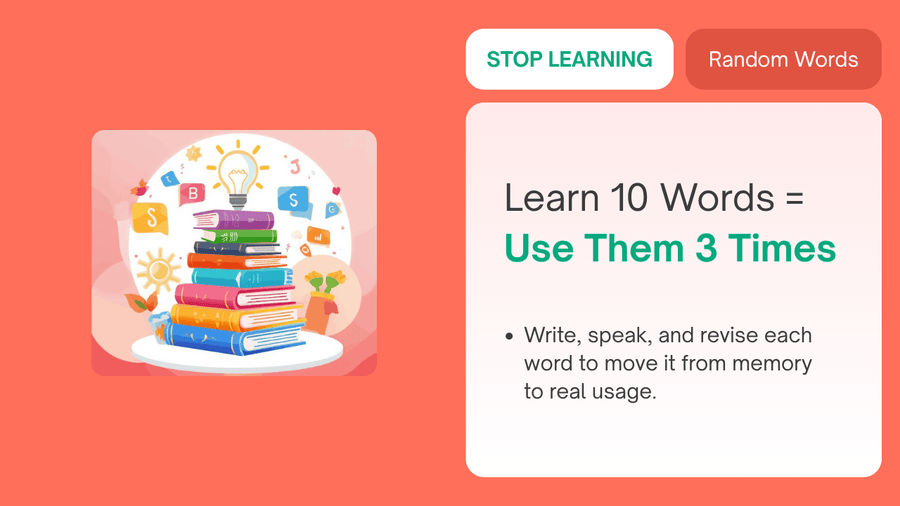
English Vocabulary Tips For You!
Week 3: Practice in exam format
Goal: Train your brain to recognize words under pressure.
What to do:
- Solve cloze tests
- Practice reading comprehension
- Attempt synonym-antonym quizzes
- Set a timer for 15–20 minutes
Many students know words at home but freeze in mock tests. Why? Because they never trained with time pressure. Vocabulary must shift from “I know this word” to “I can use it quickly.”
Week 4: Revise for retention
Goal: Make your learning stick.
What to do:
- Revise all words from weeks 1 to 3
- Mark difficult words in red
- Test yourself without notes
- Create mini quizzes every day
- Use tough words in conversation or writing
By the end of 30 days, the student who follows this system seriously will not just know more words. They will think more clearly in English.
10 Smart Techniques to Learn Words Faster
1. Learn root words
Root-based learning helps you decode unfamiliar words. One root can unlock many words.
2. Study prefixes and suffixes
Un-, dis-, pre-, anti-, -able, -tion, and -ment appear often. Learn them once and many words become easier.
3. Use synonyms and antonyms
A word becomes stronger in memory when it lives inside a word family.
4. Make your own sentence
A self-made sentence is easier to remember than a dictionary sentence.
5. Use visual memory
Turn the word into a picture in your mind. It sounds silly, but it works.
6. Revise in short bursts
Ten focused minutes beat one sleepy hour.
7. Read aloud
Hearing the word improves retention and pronunciation.
8. Maintain a personal vocabulary journal
This becomes your revision goldmine.
9. Learn high-frequency words first
Do not chase fancy words before mastering common exam words.
10. Practice mixed question sets
Real exams mix vocabulary with grammar and comprehension, so your practice should too. These methods line up with broader competitive-exam advice that emphasizes reading, journaling, usage, flashcards, and repeated practice rather than one-time memorization.
Daily Habits That Make Vocabulary Stick
Read editorials and short articles
You do not need to read a whole newspaper from top to bottom. One quality article a day is enough. Focus on understanding context, tone, and repeated words. When a word appears naturally inside an article, your brain remembers it better than when it appears in a dry list.
Keep a vocabulary journal
Split each page into:
- word
- meaning
- synonym
- antonym
- sentence
- revision date
That last column is the secret sauce. Without revision dates, a notebook becomes a graveyard of forgotten effort.
Speak and write with new words
Use new words in WhatsApp drafts, diary entries, essays, or spoken English practice. Active usage turns a word from “familiar” into “owned.” Platforms that teach vocabulary through repeated content and guided lessons can help students create this habit more consistently, especially when learning through video or app-based modules.
Common Vocabulary Mistakes Competitive Exam Aspirants Make
Memorizing without context
A word without a sentence is weak. Context gives meaning life.
Ignoring revision
Students spend hours learning and minutes revising. That ratio should be reversed.
Studying rare words before useful ones
Common exam words give better returns than obscure words.
Depending only on PDFs
PDFs are useful, but they do not automatically create retention. You still need recall, revision, and testing.
Avoiding reading comprehension
Some students say, “I only want vocabulary, not RC.” That is like wanting muscles without exercise. RC forces vocabulary into action. Resources for exam aspirants repeatedly combine vocabulary with comprehension and usage for that reason.
Best Types of Vocabulary Questions to Practice
Cloze tests
These help you choose the right word based on sentence flow and tone.
Reading comprehension
This improves contextual guessing and reading speed.
Fill in the blanks
Excellent for learning collocations and sentence logic.
Synonyms and antonyms
Useful for direct vocabulary building.
Idioms and phrases
Very common in many competitive exams and easy to score with revision.
One-word substitutions
A favorite in many English sections because it tests both understanding and precision.
How DLC The Learning Club Can Help Students Learn Faster
DLC The Learning Club describes itself as an education platform focused on English vocabulary, grammar, and complicated topics, and highlights its VOCABMETRY process across its main website, app presence, and course pages. Its course messaging also points to vocabulary for competitive exams, while its Graphy page emphasizes episode-based learning. For students, that matters because structured repetition, guided lessons, and app-based access can make consistency much easier than unplanned self-study.
What makes this relevant for SEO is simple: the brand’s actual strengths match a real student pain point. That is the sweet spot for traffic content. A blog post on how to improve English vocabulary for competitive exams can bring in:
- students searching for English improvement tips
- aspirants preparing for exams
- users looking for vocabulary courses or apps
- parents comparing learning platforms
In other words, the topic can attract informational traffic at the top of the funnel and still lead naturally to DLC’s learning ecosystem. That is an inference from DLC’s positioning and the visible search landscape around vocabulary and exam prep.
A Sample 7-Day Vocabulary Routine
| Day | Task | Time |
|---|---|---|
| Monday | Learn 10 new words + revise 10 old words | 30 min |
| Tuesday | Read one article + note 5 new words | 25 min |
| Wednesday | Practice synonyms, antonyms, and fill in the blanks | 30 min |
| Thursday | Solve one cloze test + revise difficult words | 30 min |
| Friday | Use 15 words in sentences | 25 min |
| Saturday | Take a vocabulary mini-test | 20 min |
| Sunday | Full revision of the week | 40 min |
This simple routine beats random studying every single time.
25 High-Utility Words Students Should Know
| Word | Meaning | Quick Use |
|---|---|---|
| Abate | Become less | The pain began to abate |
| Adept | Skilled | She is adept at analysis |
| Alleviate | Reduce pain or trouble | This may alleviate stress |
| Ambiguous | Unclear | The statement was ambiguous |
| Benevolent | Kind | A benevolent leader |
| Candid | Honest | Give a candid answer |
| Coherent | Logical | Write a coherent paragraph |
| Concise | Brief and clear | Keep your answer concise |
| Credible | Believable | Use credible sources |
| Diligent | Hardworking | A diligent student improves |
| Eloquent | Fluent and persuasive | An eloquent speaker |
| Frugal | Careful with money | A frugal lifestyle |
| Imminent | About to happen | Results are imminent |
| Lucid | Easy to understand | A lucid explanation |
| Meticulous | Very careful | Be meticulous in revision |
| Novice | Beginner | Every topper was once a novice |
| Omit | Leave out | Do not omit examples |
| Pragmatic | Practical | Take a pragmatic approach |
| Resilient | Able to recover | Be resilient after mock tests |
| Scrutinize | Examine carefully | Scrutinize every option |
| Sporadic | Irregular | Sporadic study gives weak results |
| Tenacious | Persistent | Be tenacious in preparation |
| Validate | Confirm | Validate your answer |
| Versatile | Able to adapt | A versatile vocabulary helps |
| Wary | Careful or cautious | Be wary of guesswork |
FAQs
1. How many words should I learn daily for competitive exams?
A realistic target is 10 words a day with revision. That gives you 300 words in a month, which is far better than learning 50 words once and forgetting most of them.
2. What is the best way to remember difficult English words?
Use active recall, spaced revision, and self-made sentences. Words stay longer when you use them, not when they only read them.
3. Is reading newspapers enough to improve vocabulary?
Reading helps a lot, but reading alone is not enough. You also need revision, testing, and usage. Newspapers build exposure; practice builds retention.
4. Which is more important for exams: grammar or vocabulary?
Both matter, but vocabulary improves multiple areas at once, including comprehension, cloze tests, and direct word-based questions. Strong vocabulary often supports grammar-based performance too.
5. Can Hindi-medium students build strong English vocabulary?
Absolutely. Many students from Hindi-medium backgrounds improve quickly when they use a consistent system with meanings, examples, and regular revision. Recent exam-prep guidance explicitly says strong English scores are achievable for Hindi-medium aspirants with steady practice.
6. How long does it take to see improvement in English vocabulary?
Most students notice better recall and reading comfort within 3 to 4 weeks of structured practice. Strong long-term improvement usually takes a few months of consistency.
7. Can an app help in vocabulary preparation?
Yes, especially when it offers guided lessons, repeated exposure, and easy daily access. That is one reason learning apps and digital course platforms remain popular for exam preparation. DLC The Learning Club’s app and course ecosystem are built around this kind of structured access.
Conclusion
The answer to how to improve English vocabulary for competitive exams is not “study harder.” It is “study smarter.” Learn fewer words, but learn them properly. Revise on schedule. Read with attention. Practice with context. Test yourself often. And use a structured system that keeps you consistent.